2026-09 Update: The terrible floods in Nepal were in an area 100-150km east of where we were. The river we were following was not affected.
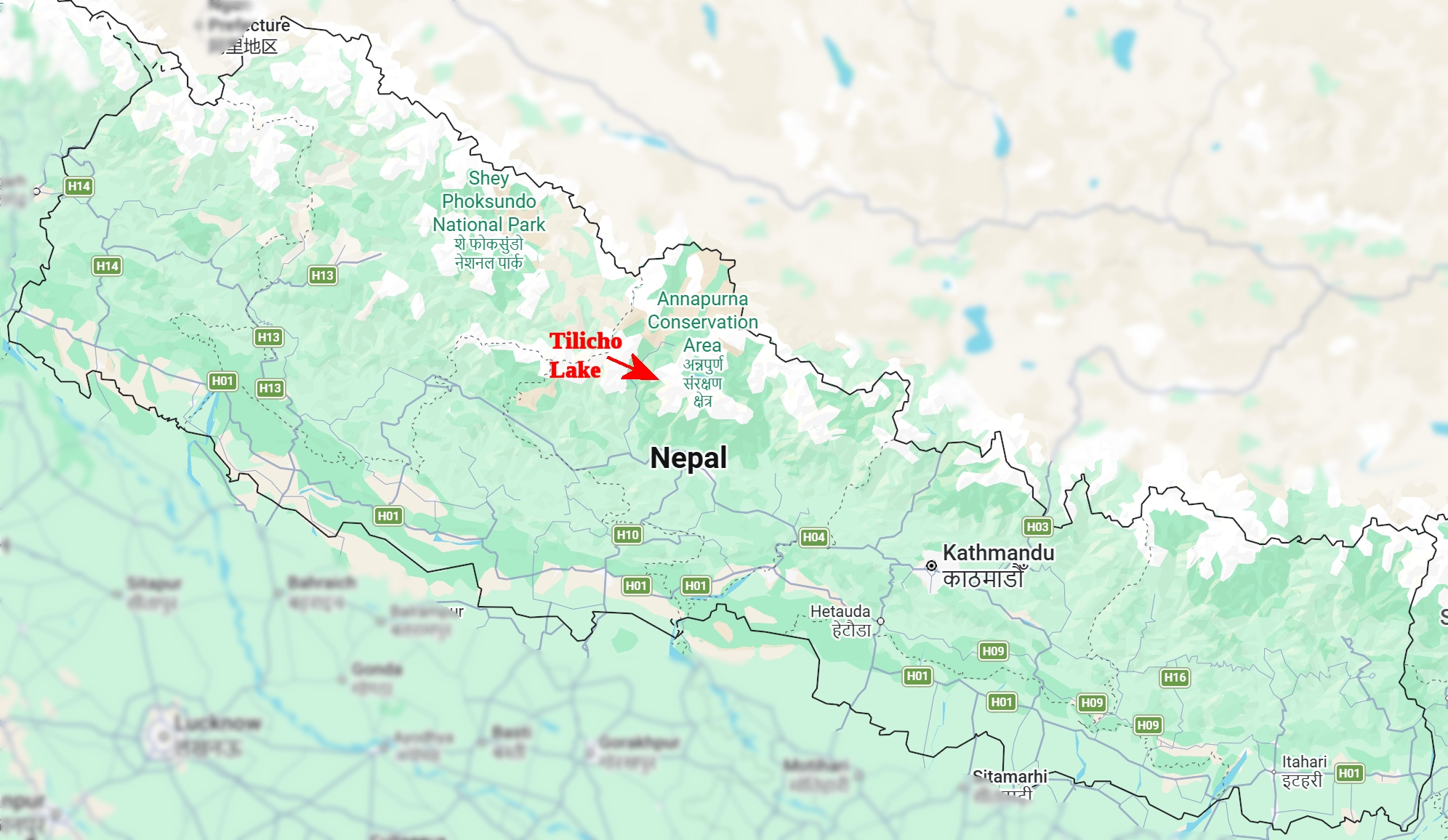
Trekking in Nepal. My brother Howard has been on the Tilicho Trek with his wife and again later with wife and a friend. In May 2026 he talked me into going with him for his third time, my first. We flew to Kathmandu then take a bus to a town at the foothills, Besisahar. From there we took a jeep up to altitude to the village Manang. The goal was Tilicho Lake at 4,920m.
This was a trek, not a climb, a lot of walking at altitude with places to stay and places to eat. Thanks to asthma, I decided to stay at 3,500m instead of climbing to the pearly gates. As the saying goes, not my mountain to die on. Howard did walk up to the lake and back to Manang in three days. It was not easy. There can be too much snow, landslides, scree slopes, old knees, altitude sickness, lions and tigers and bears. He made it but had AMS (Acute Mountain Sickness) that took him a couple of days to recover.
Nepal is a small country north of India and south of China. Find the Himalayas and you’re there. Nepal has 30 million people, a bit over 1% the size of Canada. Cozy, unfortunately not wealthy, many people work and work and take a day or two off every month.
Jeeps go up and down the mountains, takes one day to go 100km up then the next day down, takes all day on those rough roads. These are not fancy dancy SUVs, these are working vehicles, diesel with manual transmissions and a spare tire. Many are made by Mahindra (India), Tata (India) and a few east Asian makes. We did see a couple of European cars in the cities and one North American car, wierdo. The jeeps average about 15km/h on these terribly bumpy and rough roads. Trucks, many by Tata Motors, go up and down too, averaging under 10km/h. Passing oncoming or slow traffic is fun, if you are a masochist. Sometimes two vehicles meet on a blind corner and they yell to discuss who can back up to a place to pass. Real fun when one of the back tires is hanging on the edge of a 100m drop into a river and you are looking down and find god. We hitchhiked on the last trekking day, got a ride in an empty truck with the ubiquitous young helper. Going downhill, empty, we could have jogged faster. It had to back up to turn on some switchbacks, pressed against a rock wall so another truck could pass, they refused to take any money at the end. Dumb us, thought later to ask them to give it to someone who needs it. Too late.
Nepalese can understand Hindi but not the other way around. English is the common language. School kids learn it from at least age five and are happy to blather away. If no English then we used a translate app, only to find out that some middle aged and elderly Nepalese are illiterate. We waved to folks in the mountains: the young ones wave back, middle aged give a thumbs up and the elderly are confused about why we are flapping our hands in the air. Speaking of, when walking and passed by a jeep, they are often so slow we sometimes did high fives with the passengers on the way past, unless they were bounced around and missed our hand.
Especially in the mountains, the people are friendly and easy going. They are fair and honest, for example they ask no more than what a meal or hotel room is worth, no more, no less. The bank was funny. They record the serial number of each foreign bill, reject any imperfect because the man said that cannot reliably confirm them, questionable bills must go to the big city banks. There is only one road so the bank just leaves stacks of money behind the teller. What would a bank robber do? Steal money then ask a jeep to take them down? I would have liked to take a picture but that was inappropriate.
All is not sweetness and light. There was a sign by a police station against spousal assault. Shops in the cities have full metal shutters, although some have minimal doors for night. We did see a couple of drunks (drugs?), we saw no homeless sheltering wherever they could. Many people live hand to mouth. Crime stats show that Nepal has significantly less crime than Canada.
We noticed the small families everywhere, city and mountains. This was confirmed by Nepalese, families have one and sometimes two children, rarely three. This will bode badly in the future. Young adults will have a choice of spending their lives watching the back end of yaks as they labour plowing the fields, or going to Kathmandu. Easy choice. Many mountain villages will empty out in a generation or two. I said it was education causing smaller families, someone agreed and added condoms.
About half of the trekkers were Nepalese and Indian, they mix together effortlessly, even though Nepal is Buddhist and India is Hindu. Many of those had motorcycles, biggest was 350cc (Royal Enfield made in India). The next largest group were Israelis, fresh out their mandatory army duty and wanting to see the world. The rest were a mix from all over the world, except all but none from Russia, South America, Africa or the US. Roughly equal mix of male and female, usually in groups of two to five, some solo and might join up with others. Most trekkers were in their 20’s, some early 30’s. I was the oldest at 71, two were in their 60’s, plus Howard at 66. As we said, the young folk trek up and over the Thorong La pass to the other side (about 18-25 days) while the seniors trek down. I was surprised at how often I was asked my age.
Our target lake, Tilicho Lake at 4,920m altitude, is at the centre of Nepal to the north, where they keep the mountains. The area is called Annapurna with several real mountain climbs over 8,000m. The fatality rate for climbers at Annapurna 1 (peaks easy to remember: 1, 2 and 3) has dropped from 35% to 20% in the last decade, ouch, which is another league from our trek. League, as in a whole different class, not that 4.8km thing.
The trekking route has been around since about 1977 when Nepal was officially opened to foreign tourists, although many hippies trekked there. The road up into the Annapurna mountains was built in the 1990’s (to be confirmed), it ends a few km past Manang. For millennia before that, walking and horses and yaks were the transportation. The full Annapurna trekking route goes up and over the Thorung La pass at 5,500m. We old folk did a truncated version.
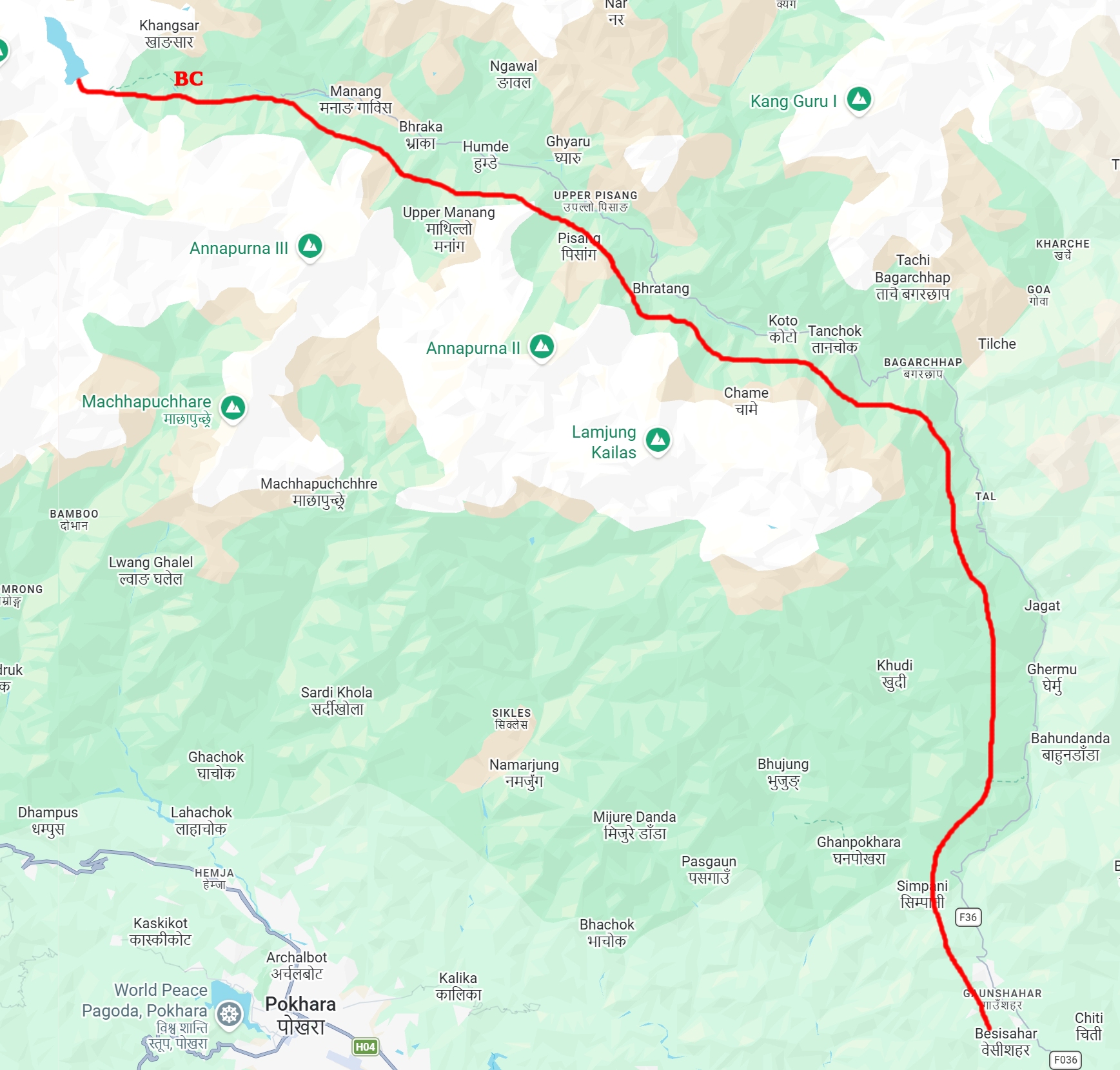
The Tilicho Trek route is in red, “BC” is Tilicho base camp.
We flew in and out of Kathmandu, taking a crowded bus from Kathmandu (the ‘th’ is pronounced as ‘t’ like in German) to 1,700m then a crowded jeep to 3,500m. There are jeeps, motorcycles, porters, horses and mules along the route and we used some, just to support the local economy of course. We took rooms and meals along the way. We walked down for a few days then a bus to the second largest city, Pokhara (pronounced poke-er-rah) then back to Kathmandu. One 14 seat micro bus (we call them vans) had up to 22 people in it. Quite cozy. A young local shoehorned in near me, Shoeman (phonetically), was interested in who we were and where we were going, nice guy.
Audio Blog
I tried to do a written blog, no go, far too hard on a phone in the circumstances, so switched to an audio blog. It is only slightly edited down. Version #3.13 of the audio blog is here. Length is 2 hours 18 minutes.
Pictures and story
As of this writing, I am waiting for more of Howard’s pics to be added. Coming soon, I hope.
* From Kathmandu up into the mountains
We took a crowded bus (about 150km in 8 hours) from Kathmandu to Besisahar at 750m altitude in the foothills, then a crowded jeep (100km in 8 hours) to almost the end of the road to Manang at 3,500m.
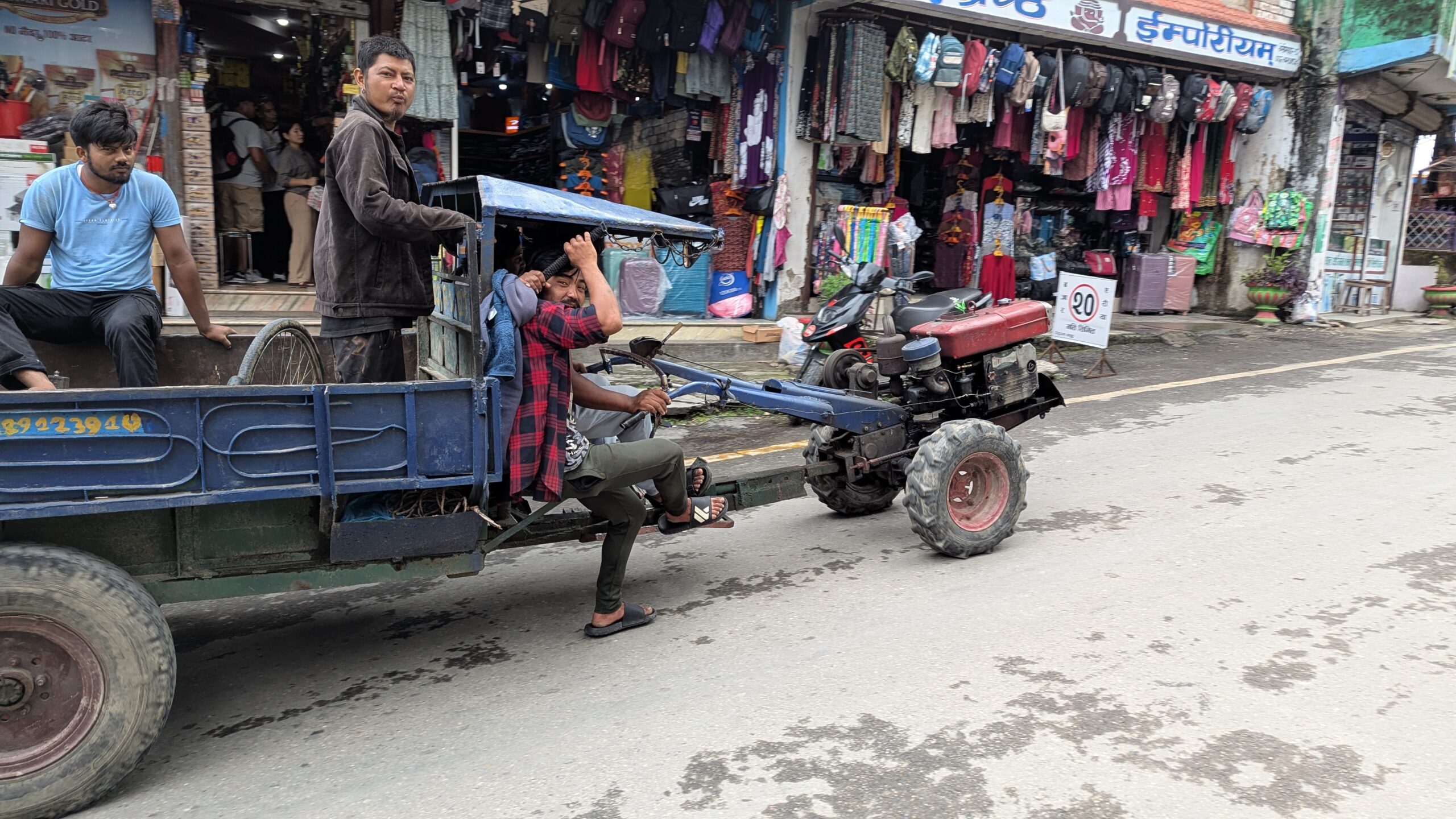
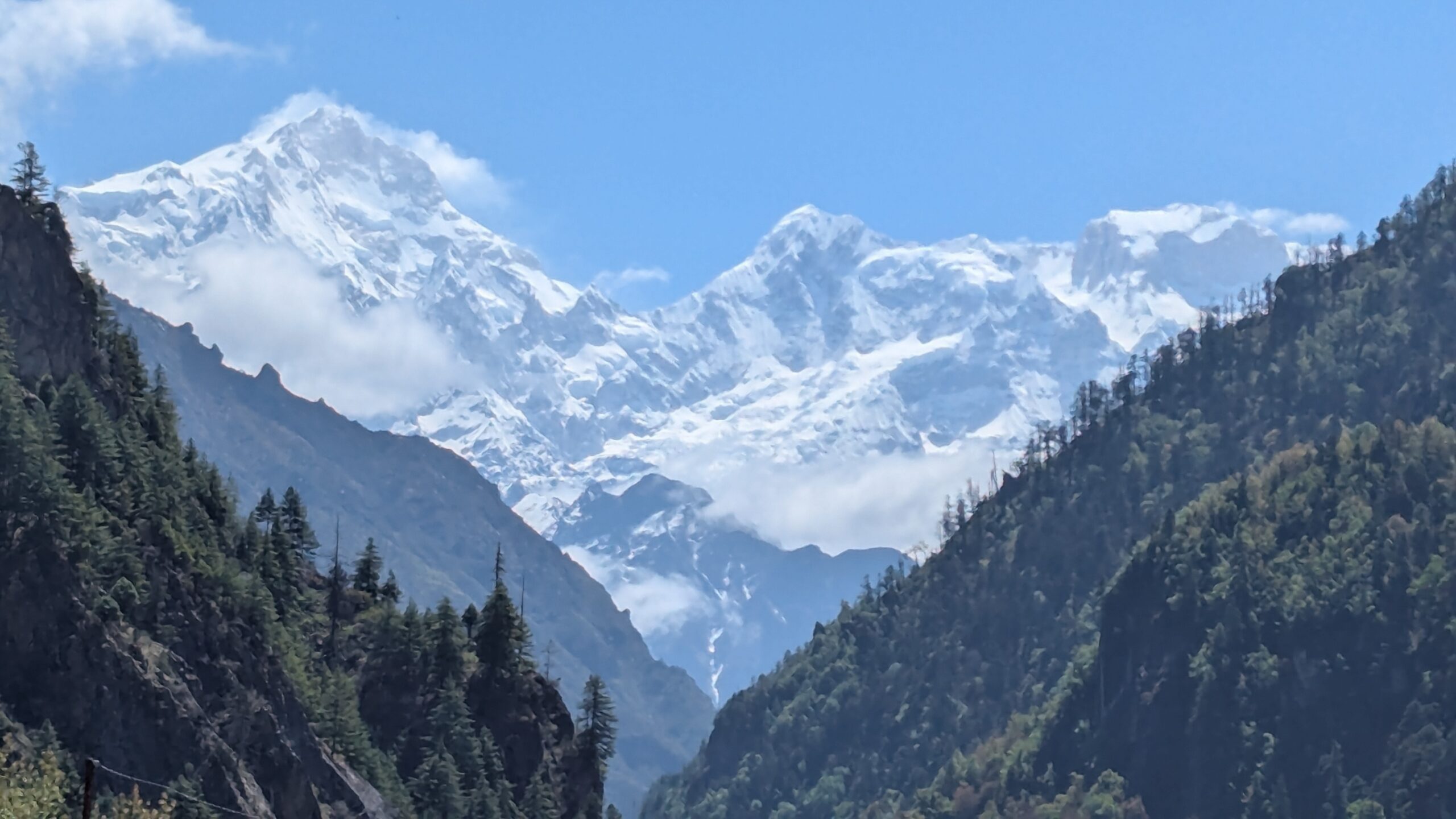
Common chopper style truck in the cities. Seems a tad dangerous, but inventive. The camera (AKA phone or mobile) caught them at a sour instant, they waved and smiled a second later. Nepalese are friendly and open.In a micro bus (we call it a van) going on highway NH25 up into the mountains, hit a good patch of concrete. An oncoming micro bus might or might not have room to pass, so one or the other waits or finds a wider spot. When meeting an oncoming truck, the micro bus loses, it has to back up to wherever there is space.This turned out to be the money shot. In the Annapurna range near Chamé, those mountains are 8,000m high, a rare clear day. People climb those things! The left mountain is Annapurna 1, 8,100m high, rated as one if not the most dangerous climbs in the world. In 2014 the death rate was 35% of those who summitted, as of 2024 that had dropped to 22%. That is comparable to nearby K2 at 8,600m. By comparison, Mt Everest at 8,850m has a death rate of just over 1%.
* In Manang
Manang is an old village in the Annapurna mountains at 3,540m (so says the sign), but nothing is flat because of the, well, mountains. The climate is a bit colder than Toronto, maybe similar to Edmonton. Locals are farmers of crops, goats, cows and yaks.
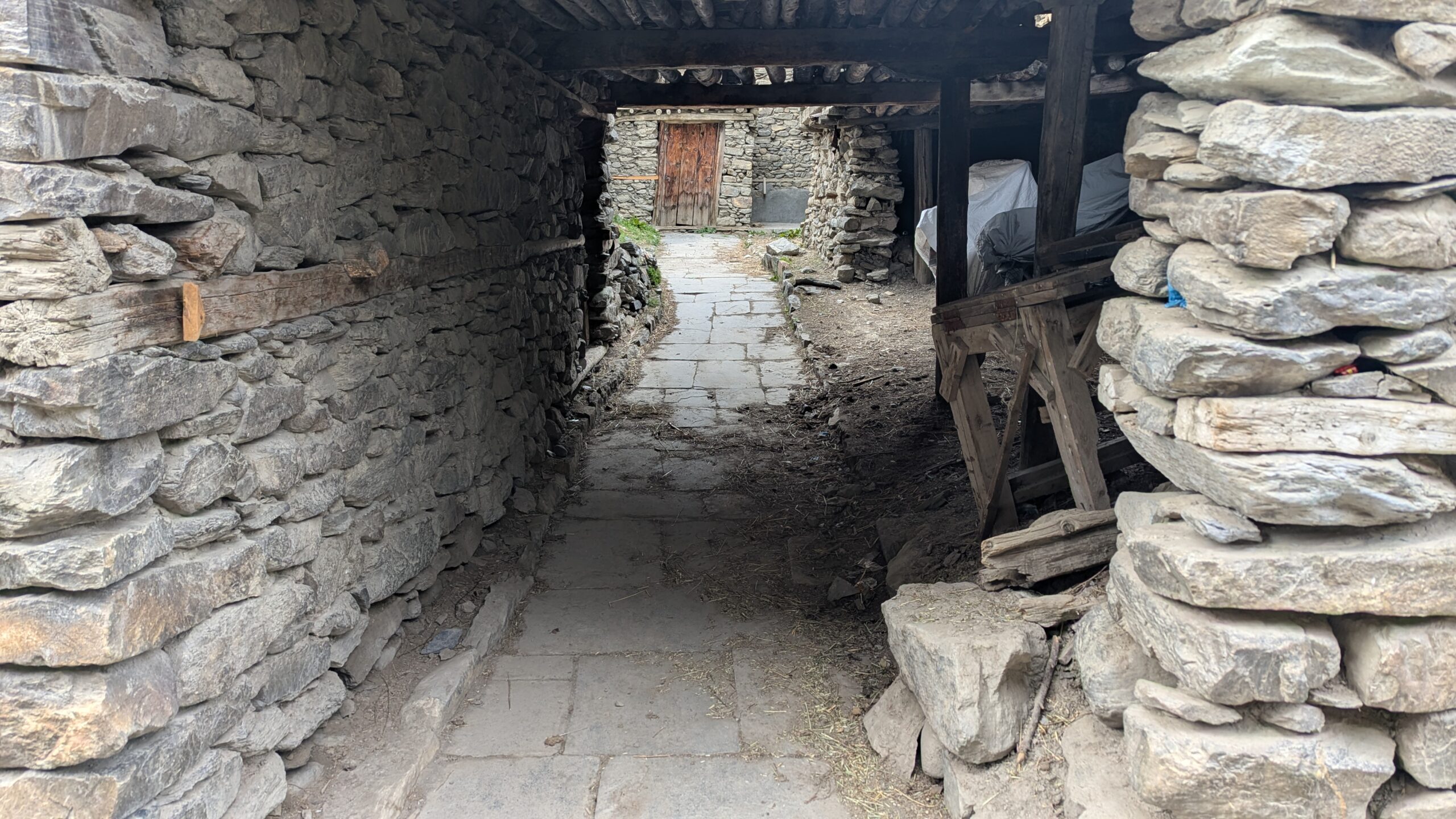
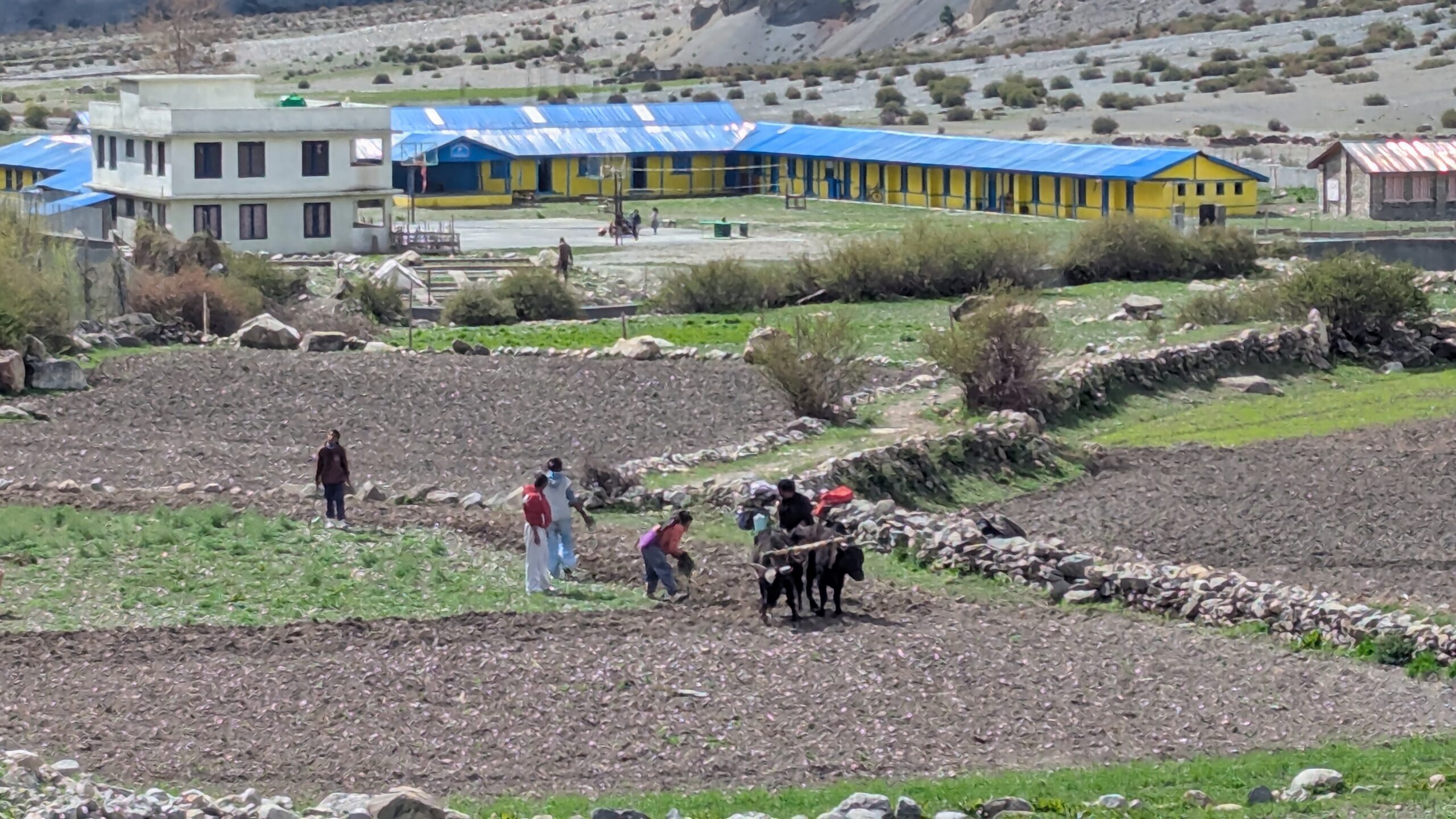
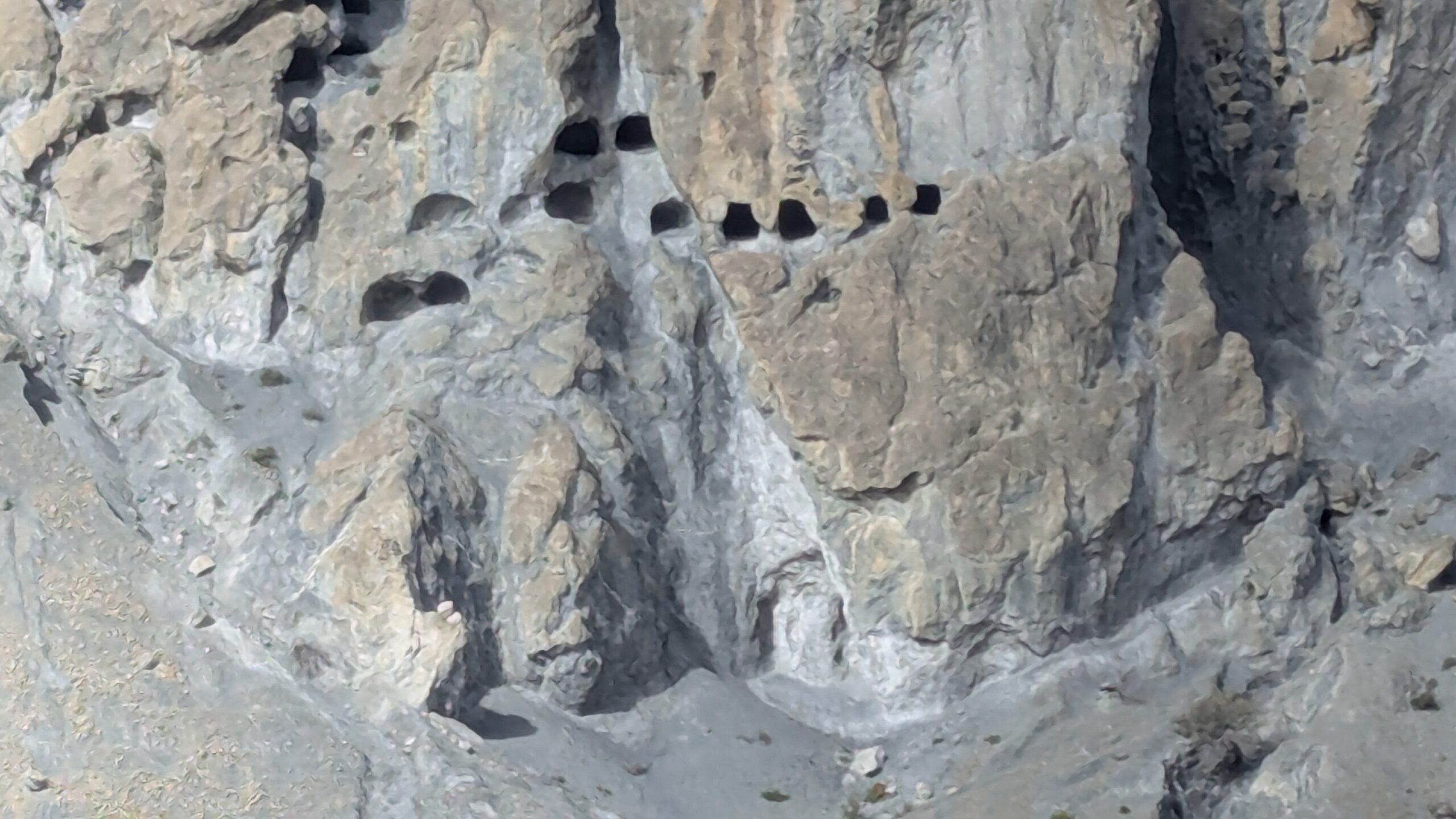
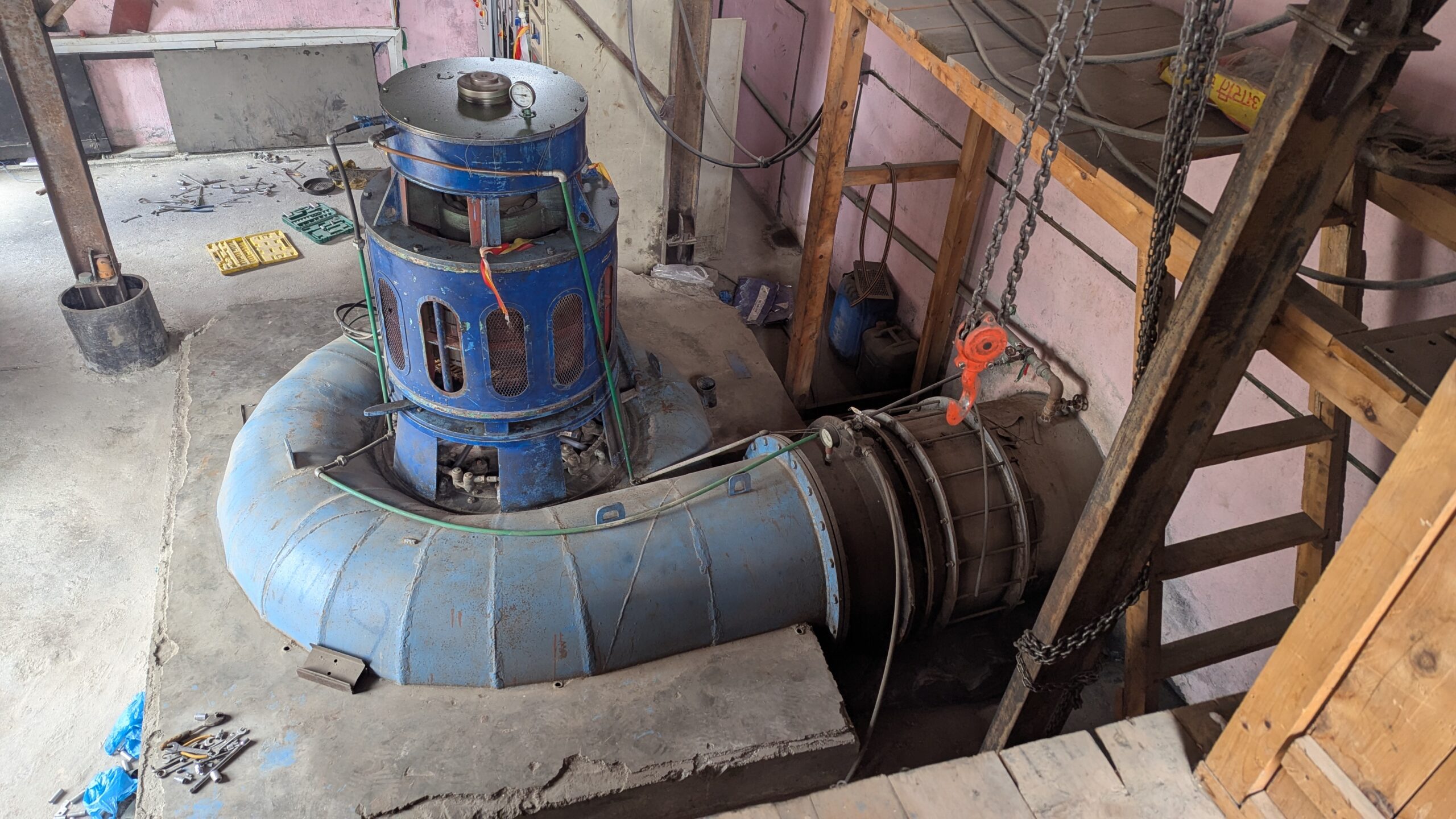
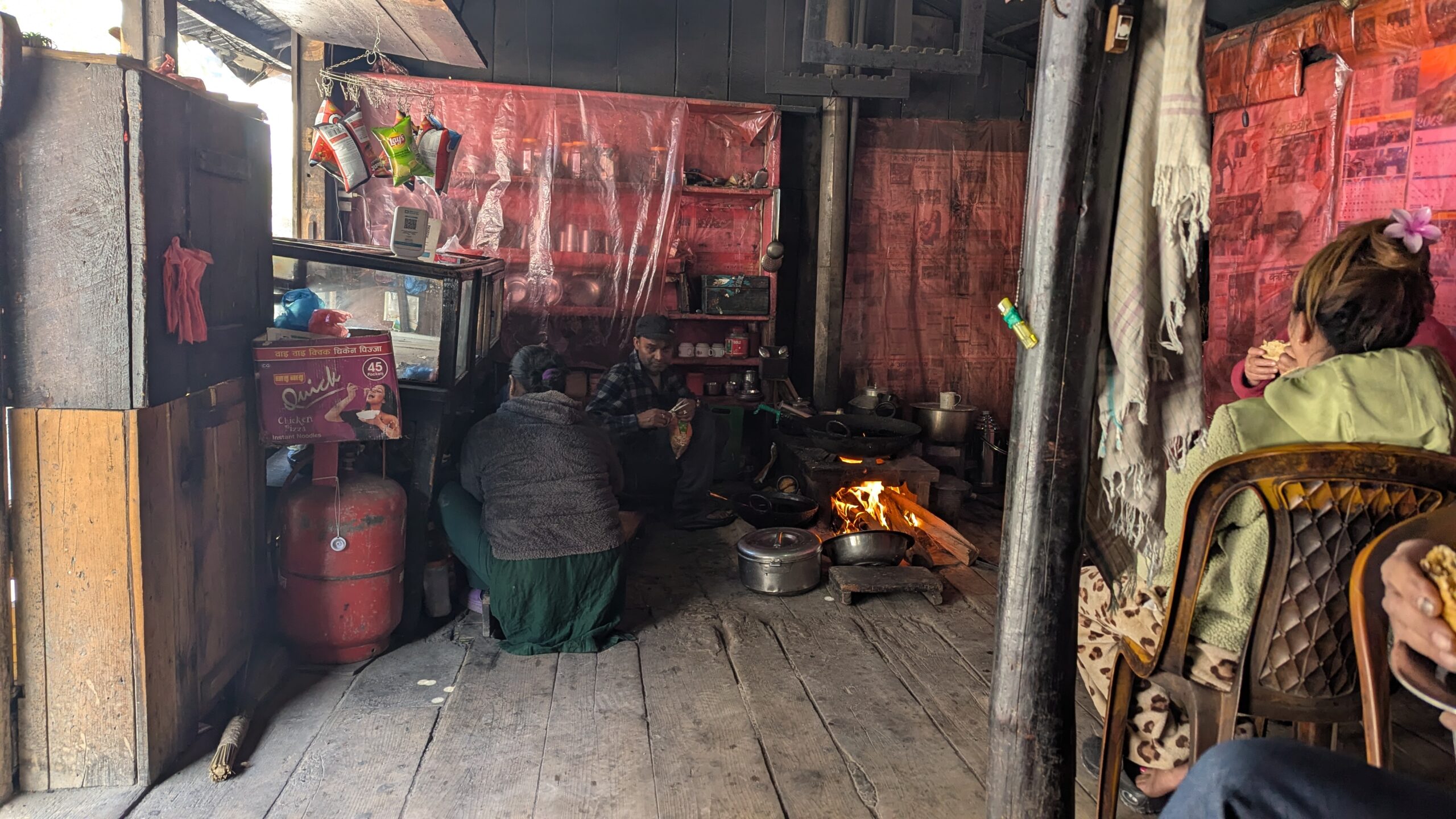
A walkway in the old part of Manang, just stacked stones, some mortar on left. Cement can be made in the mountains so concrete is ubiquitous. Common to see walls with rocks and exaggerated mortar for decoration. All cement is hand mixed with shovels and trowels, saw a few broken cement mixers.Tilling the fields in Manang with two yaks pulling a plow, school in background. The ploughing is hard work, the women and elderly pick out stones and weeds. In the school, the largest class we saw was five children, preschool starts for 3-year olds. Because of the low birth rate, the school is half empty and getting emptier. These schools are built and run with the assistance of various NGOs.Unknown who dug those caves, quite old, like the monks who still sometimes go there. We tried, got within a few metres but decided too risky to do the last bit. No monks or cave bears there.The local hydro station in Manang, 160kW. The door was open so we went in, the attendant man and wife showed up after a while, quite friendly but little English. When the power went down for hours in other villages, Manang was still ticking away.
* Walking down out of the mountains
We walked for several days, 14-18km a day. Started in sweaters and winter coats (except at the very start), gradually down to t-shirts as we descended. The trees became denser, then deciduous trees and bamboo. The forests at at 2,000m could be mistaken for the Canadian shield.
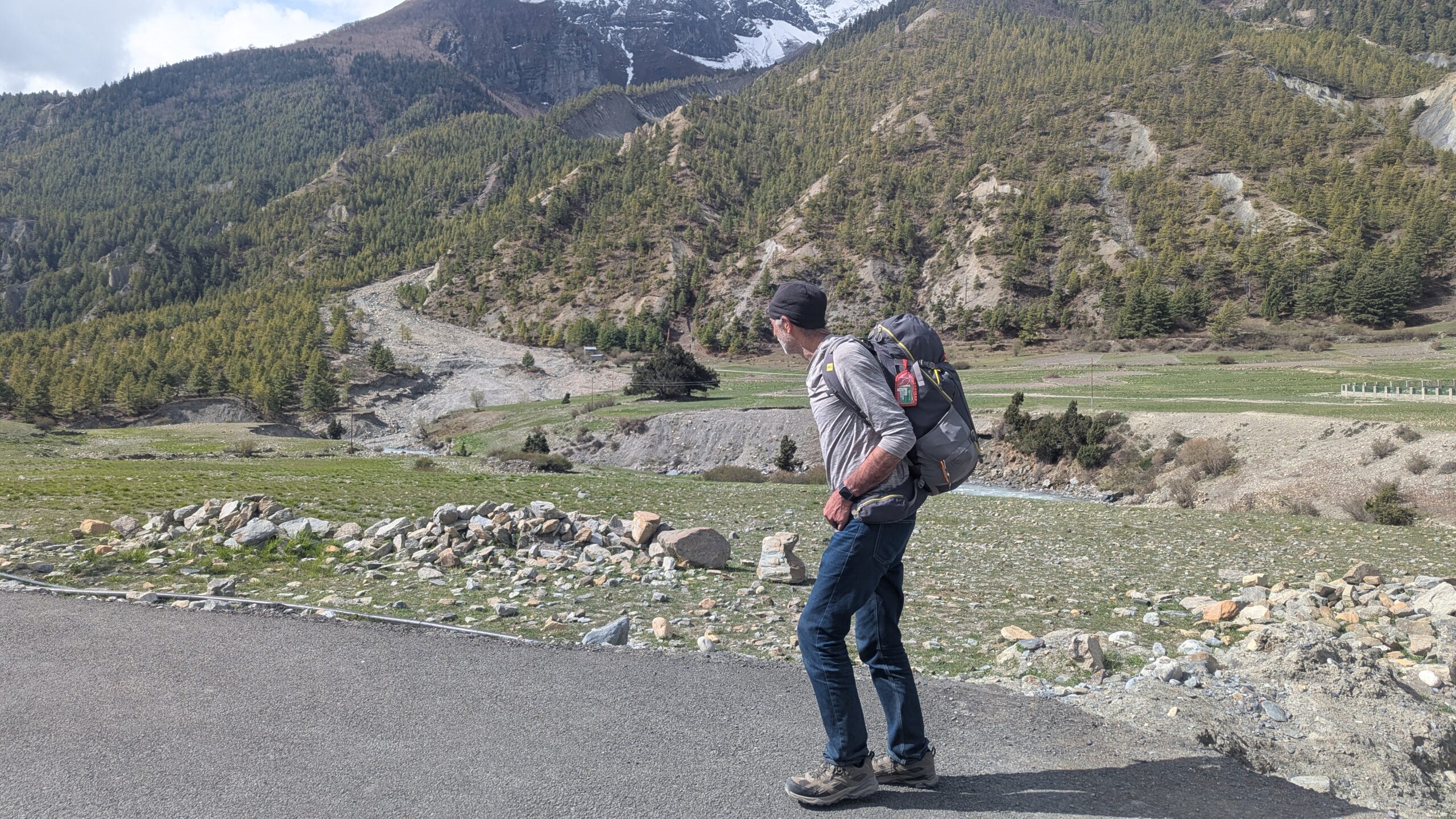
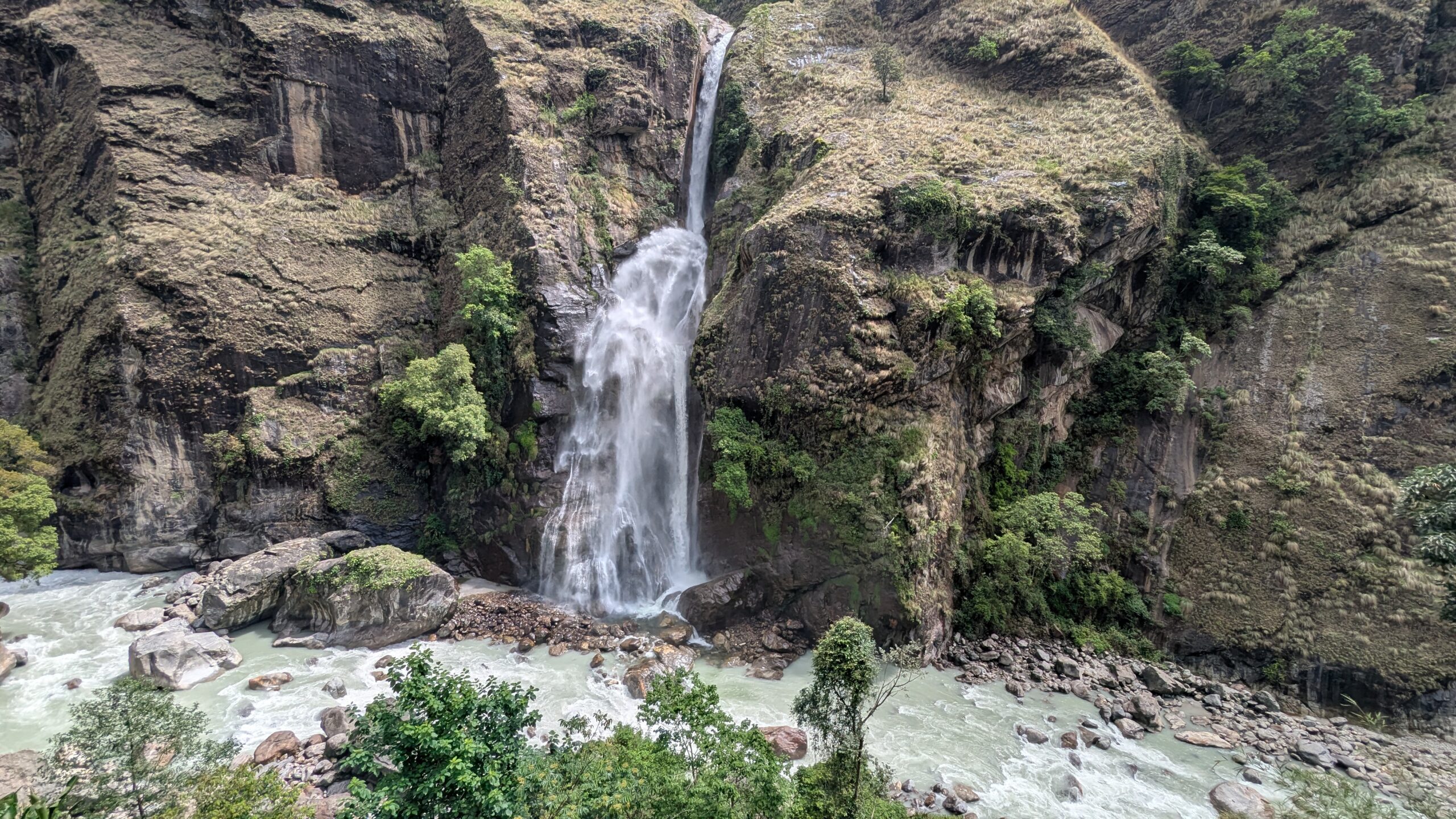
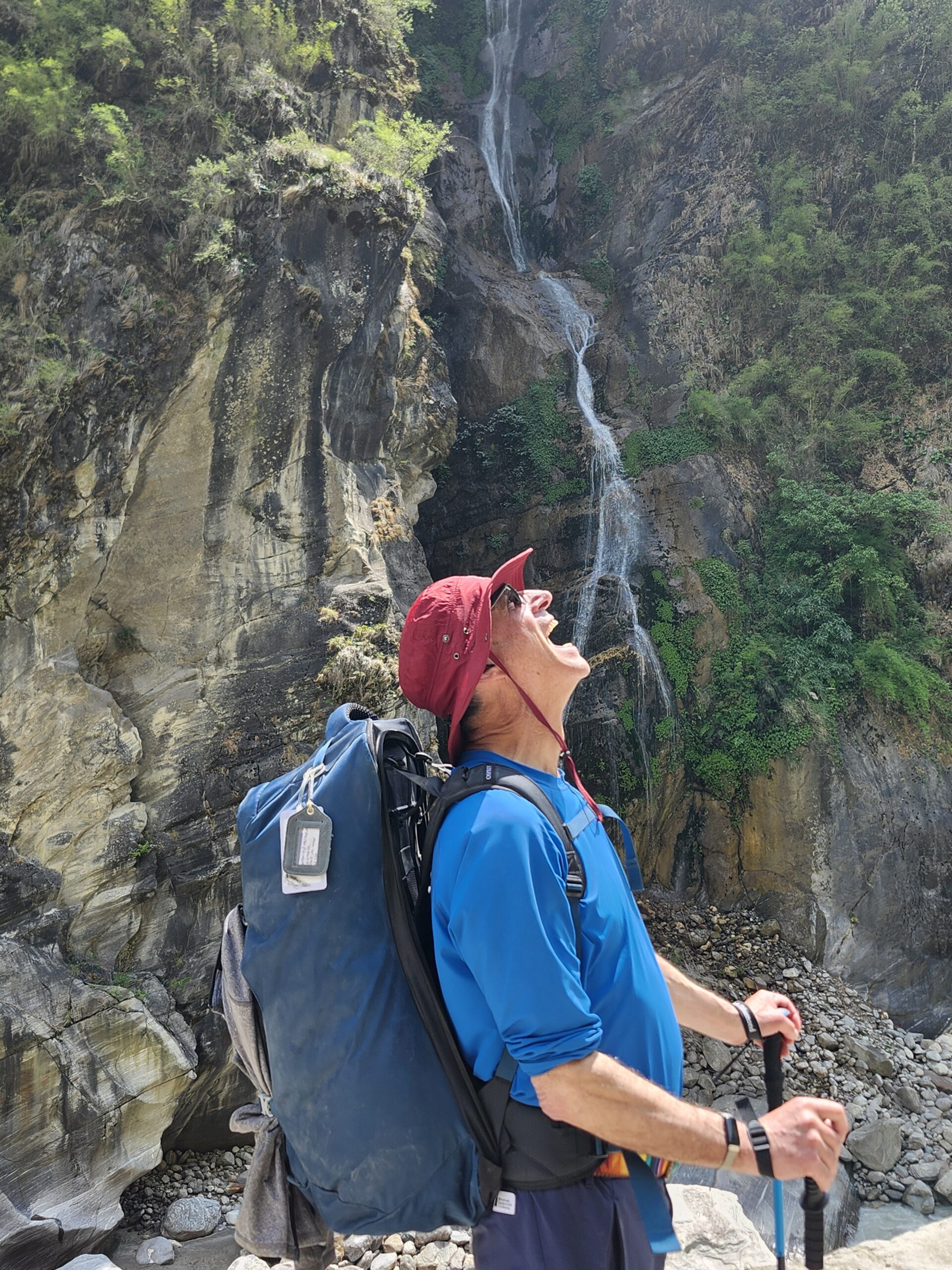
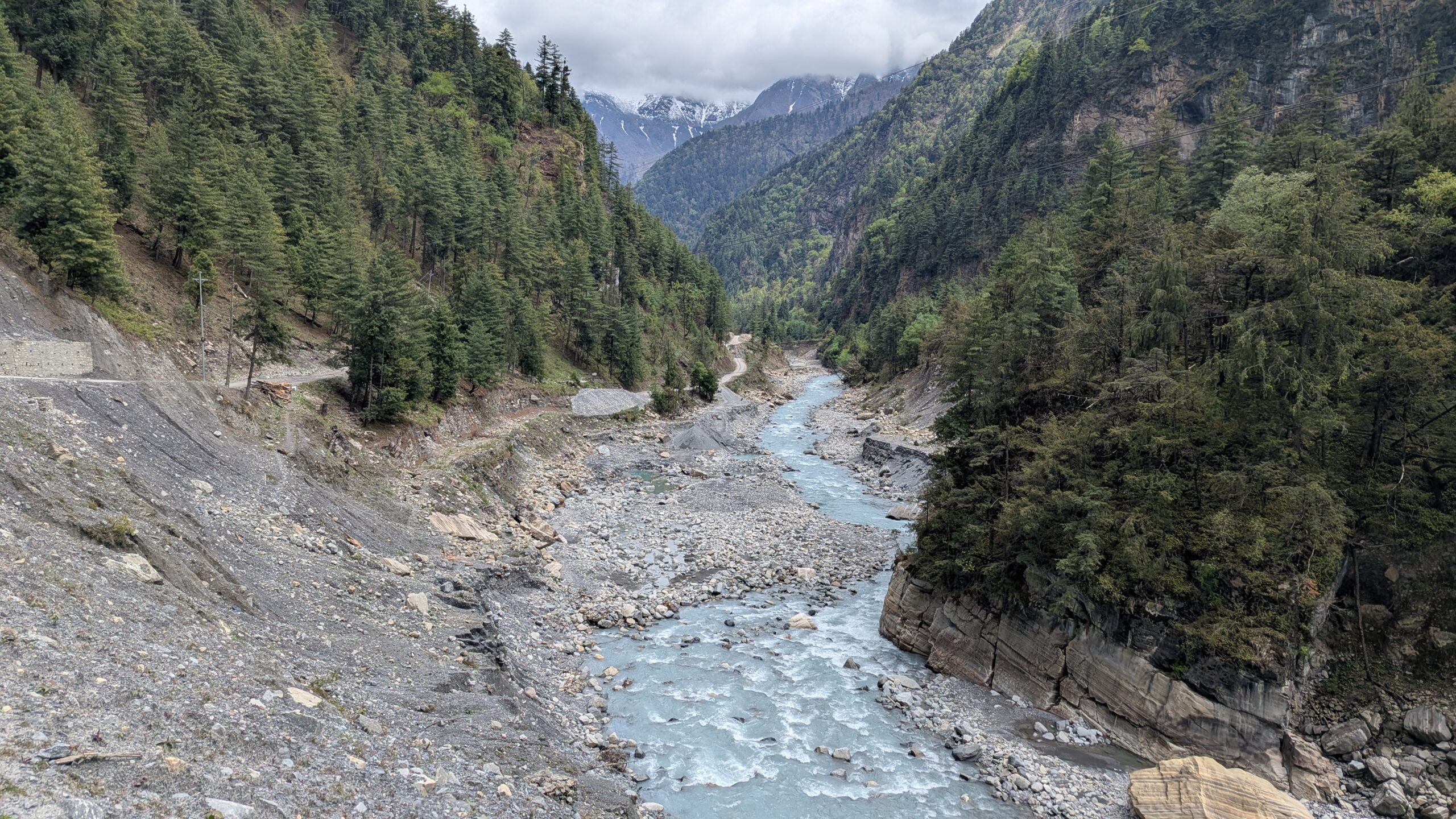
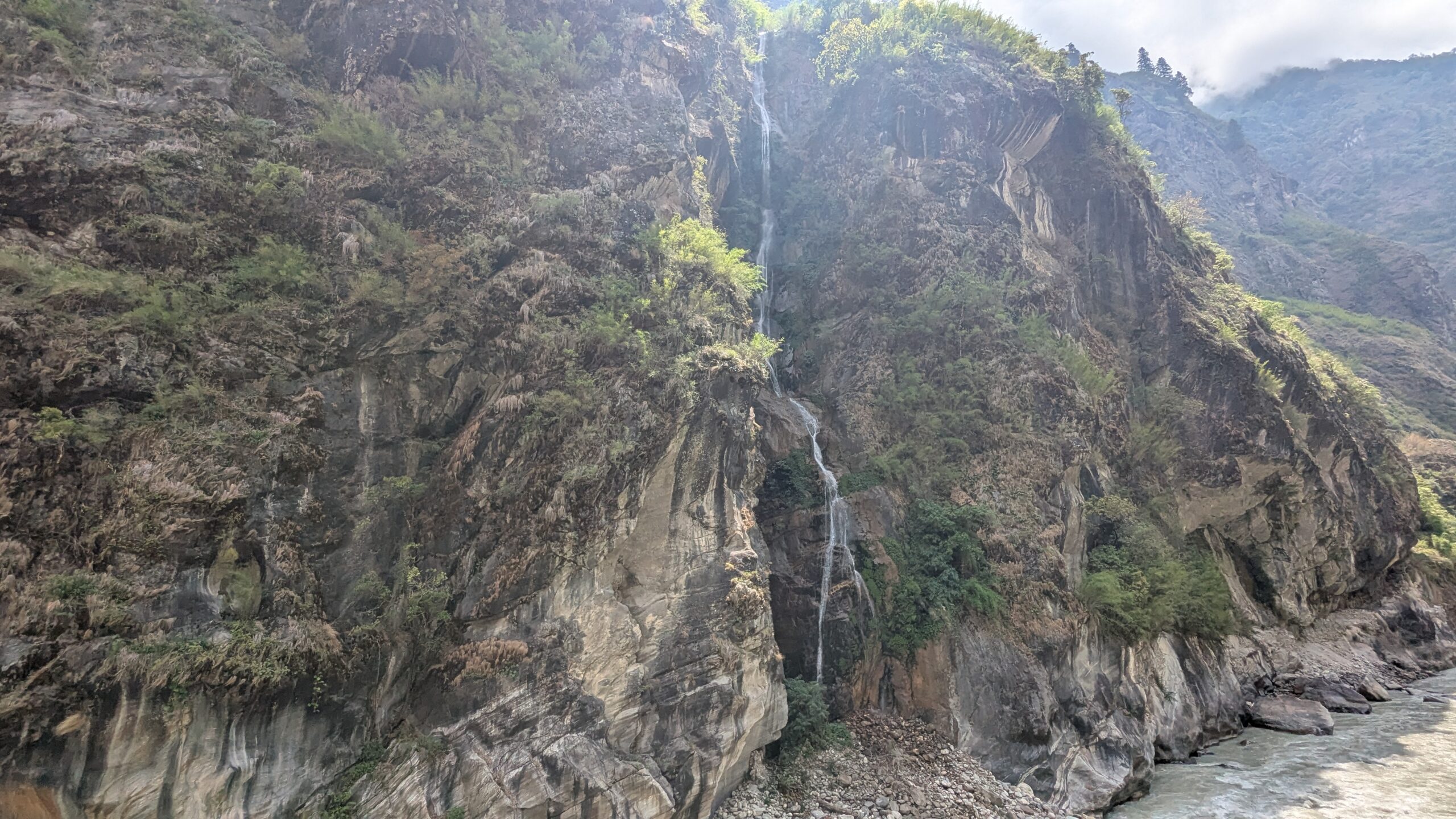
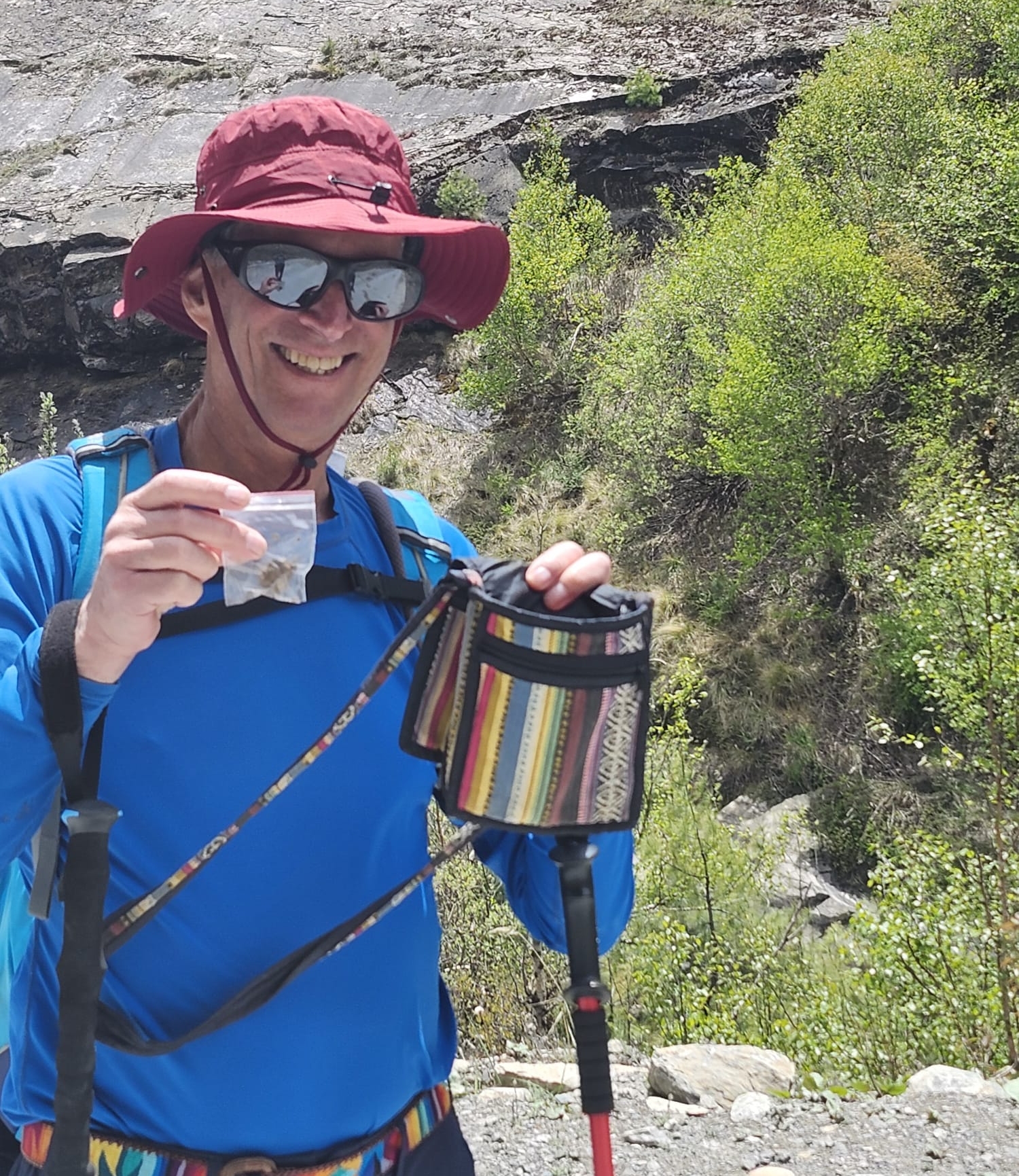
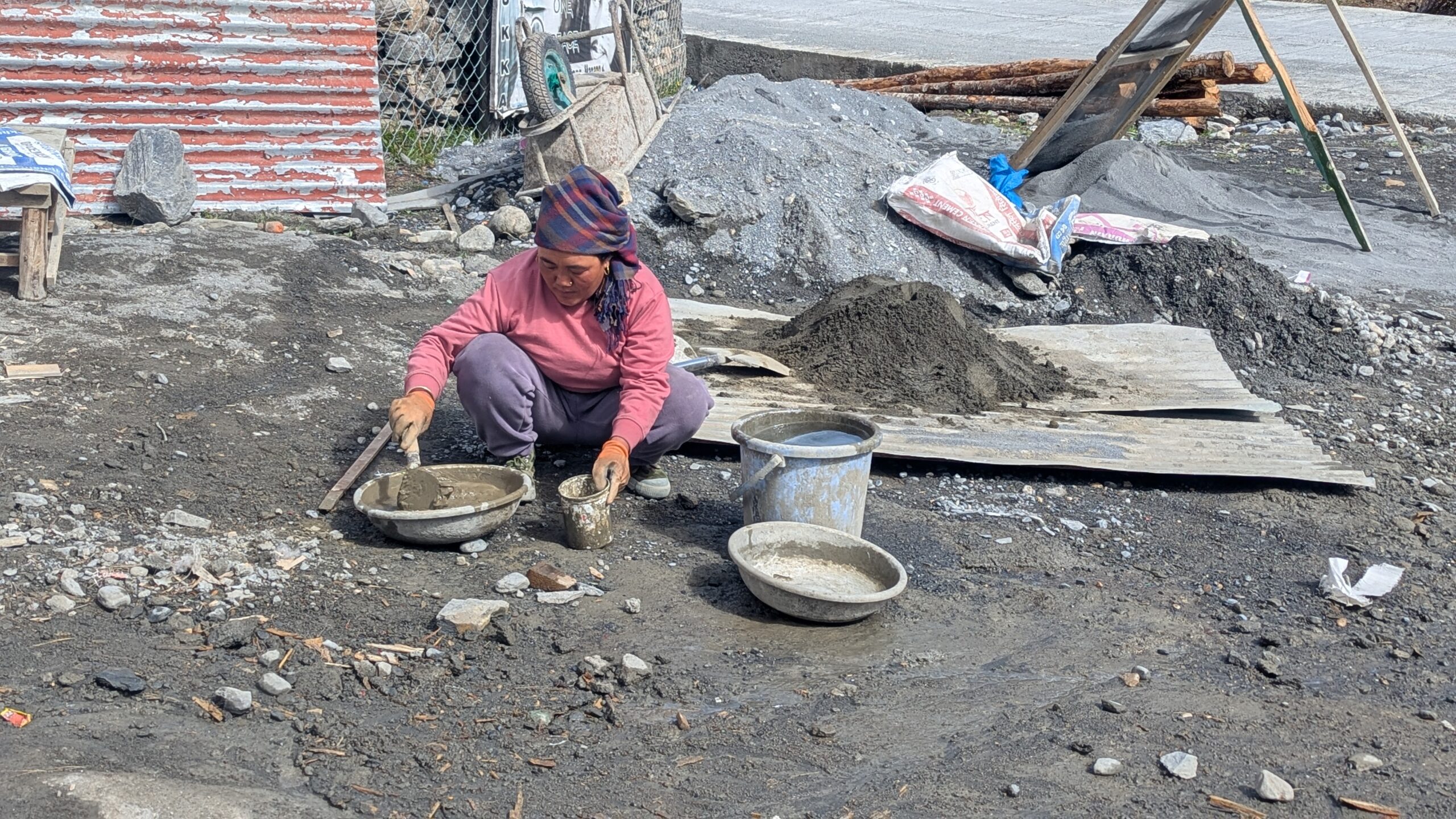
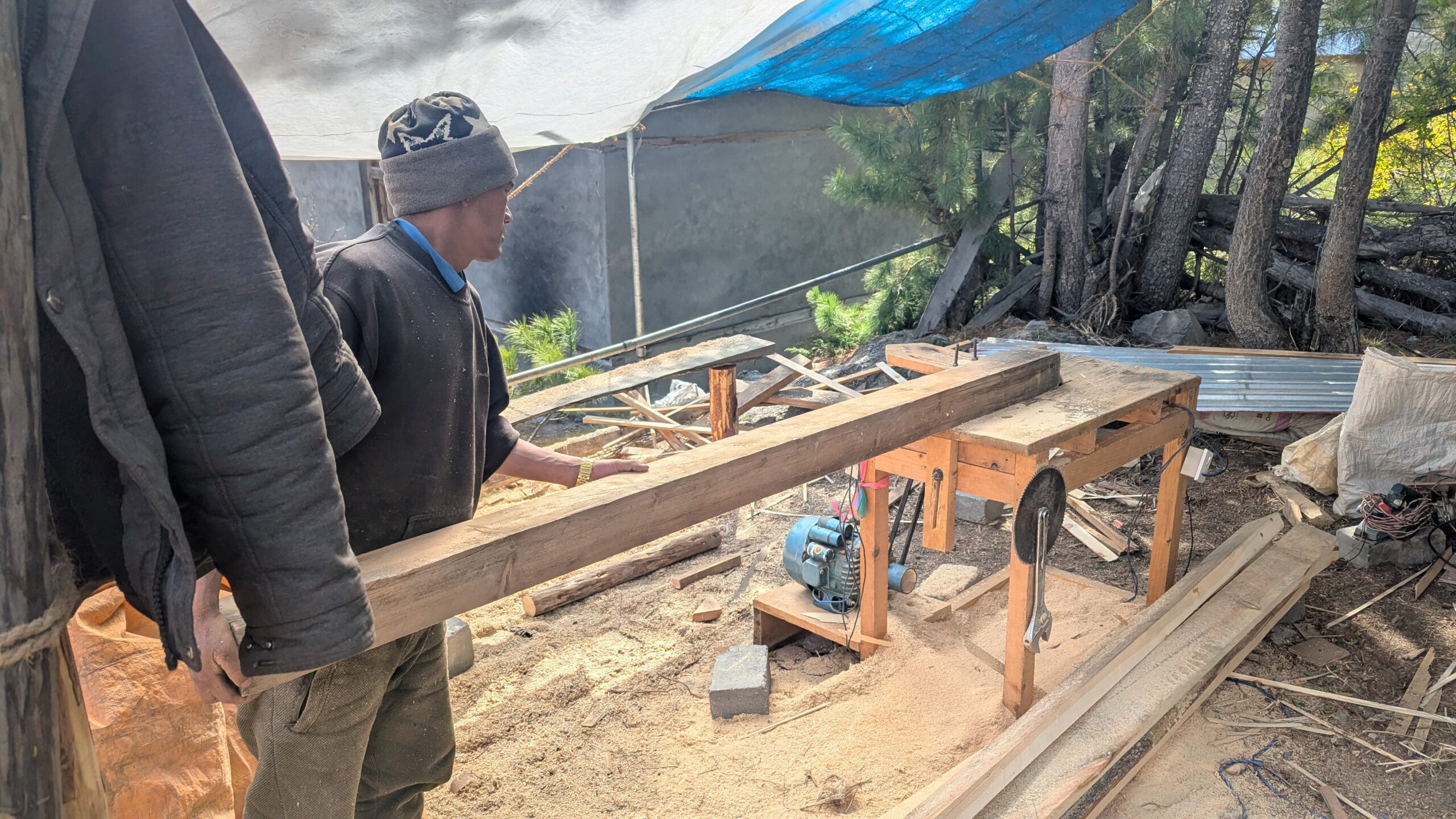
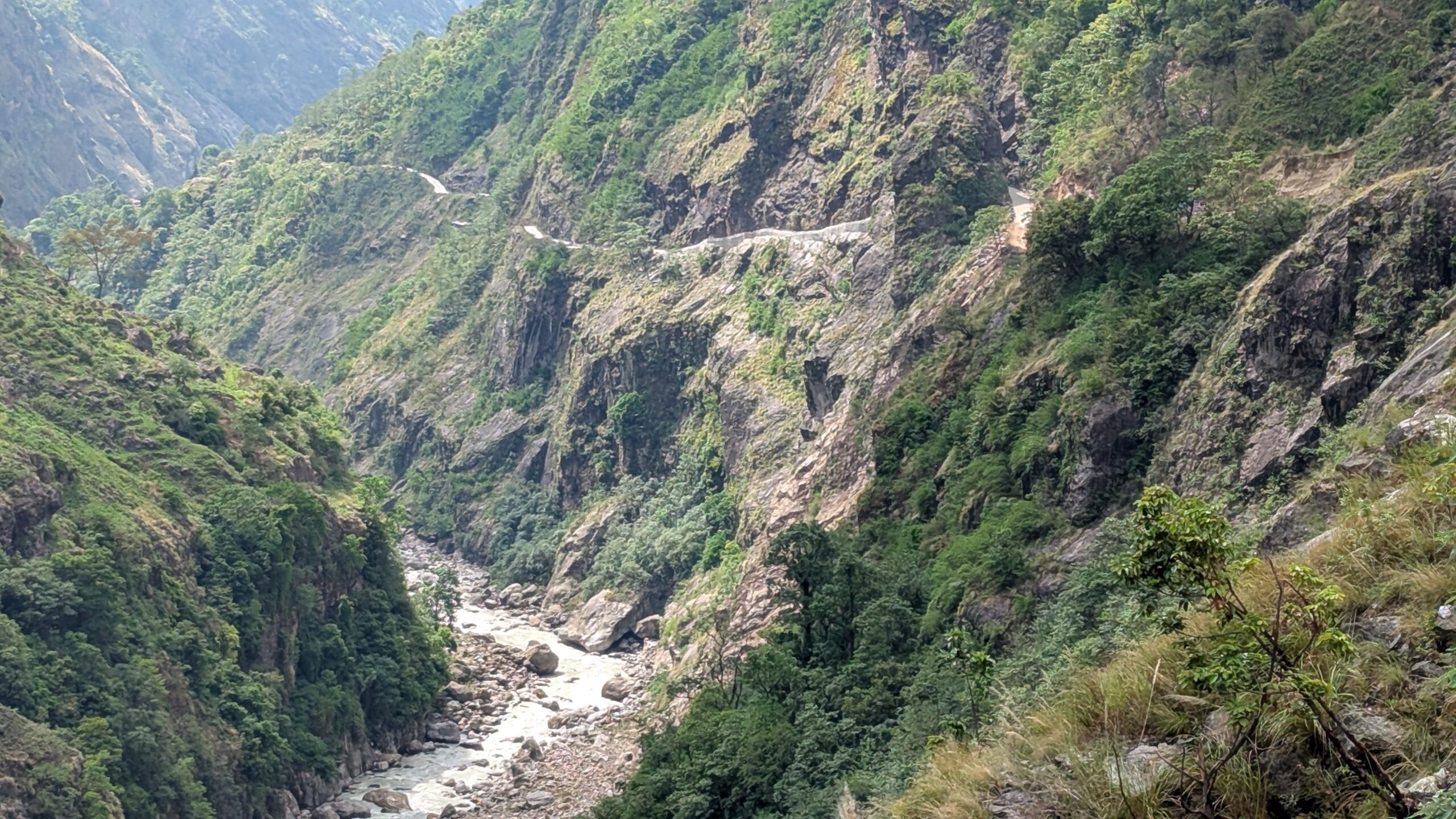
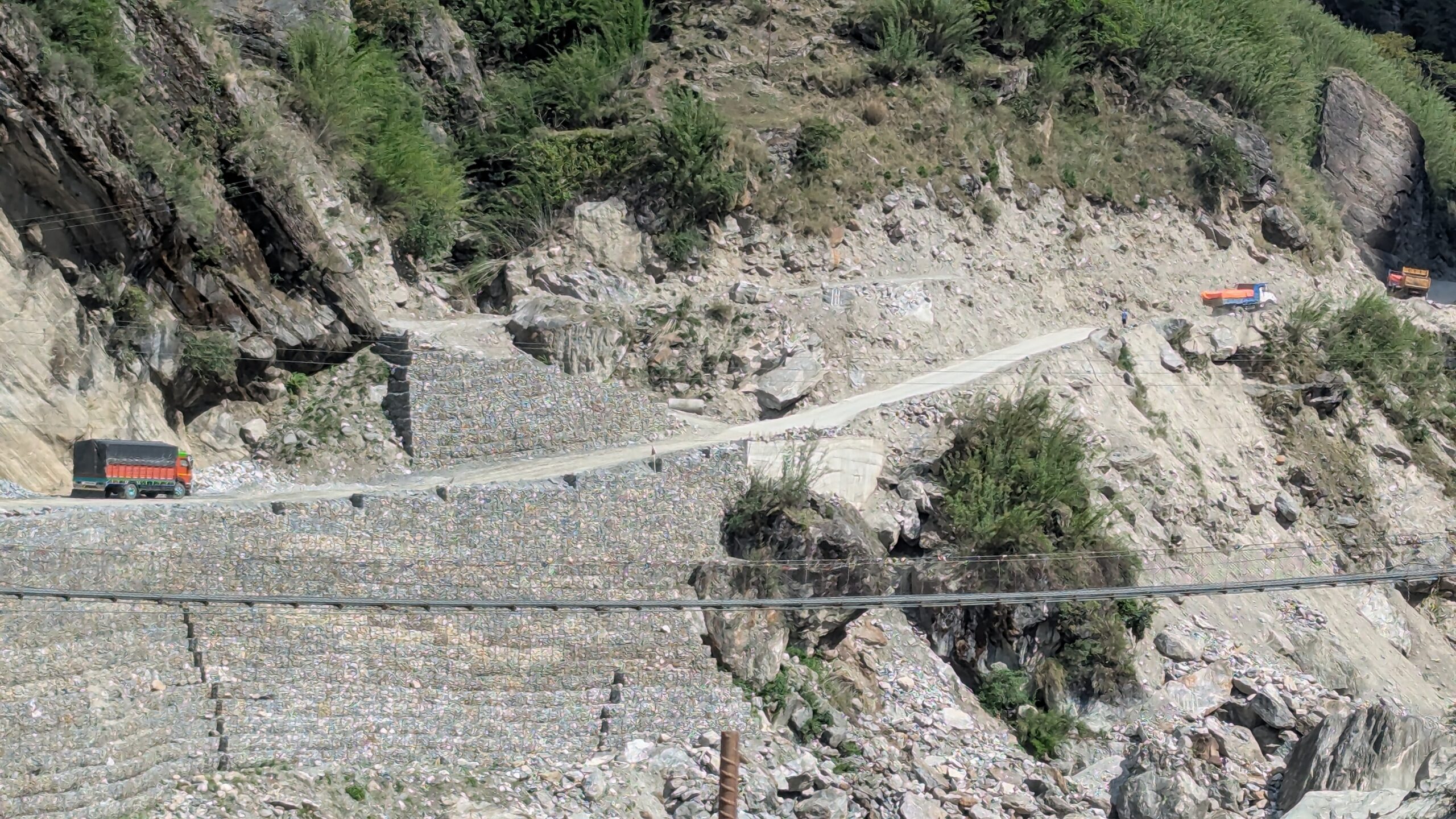
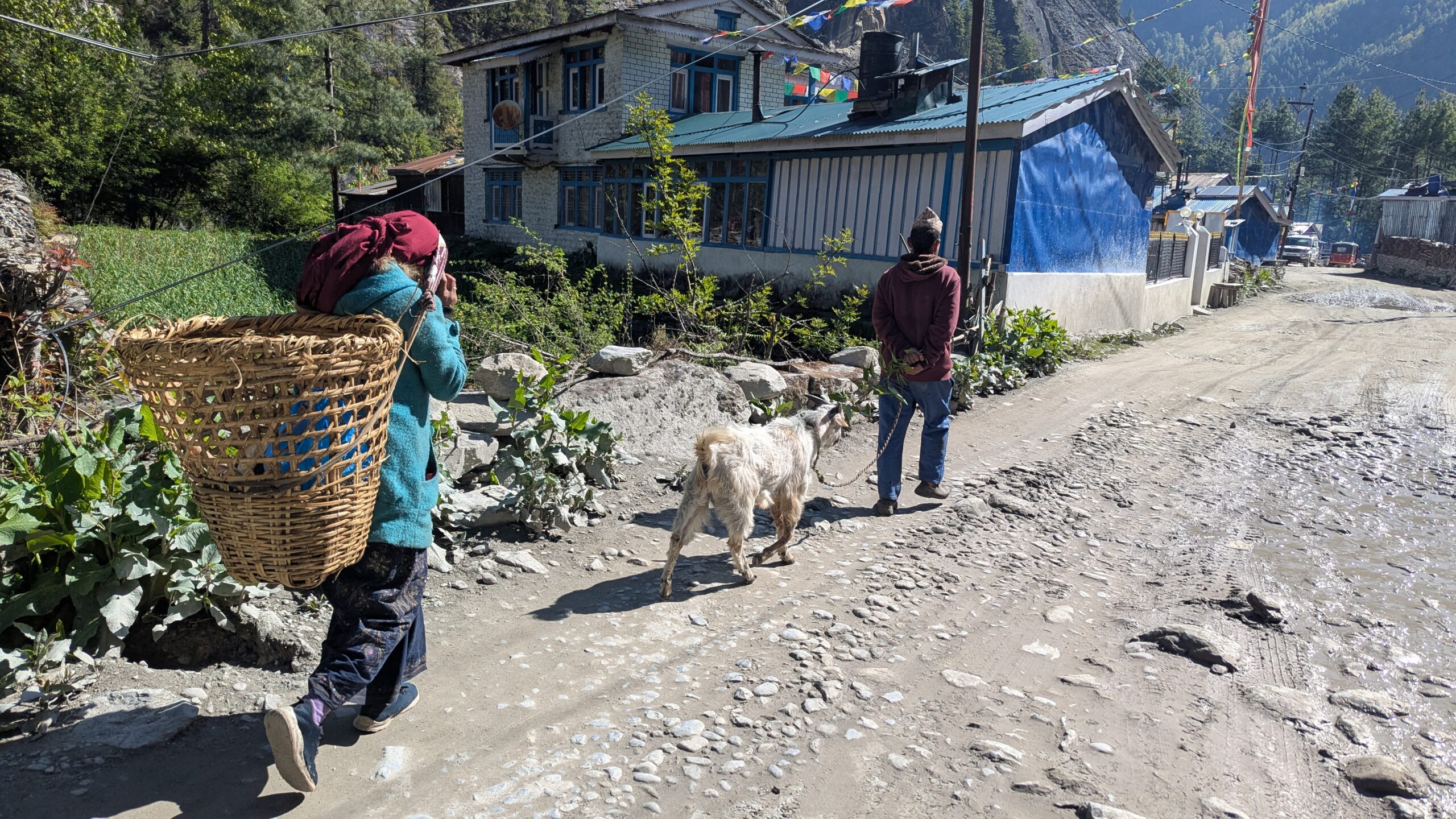
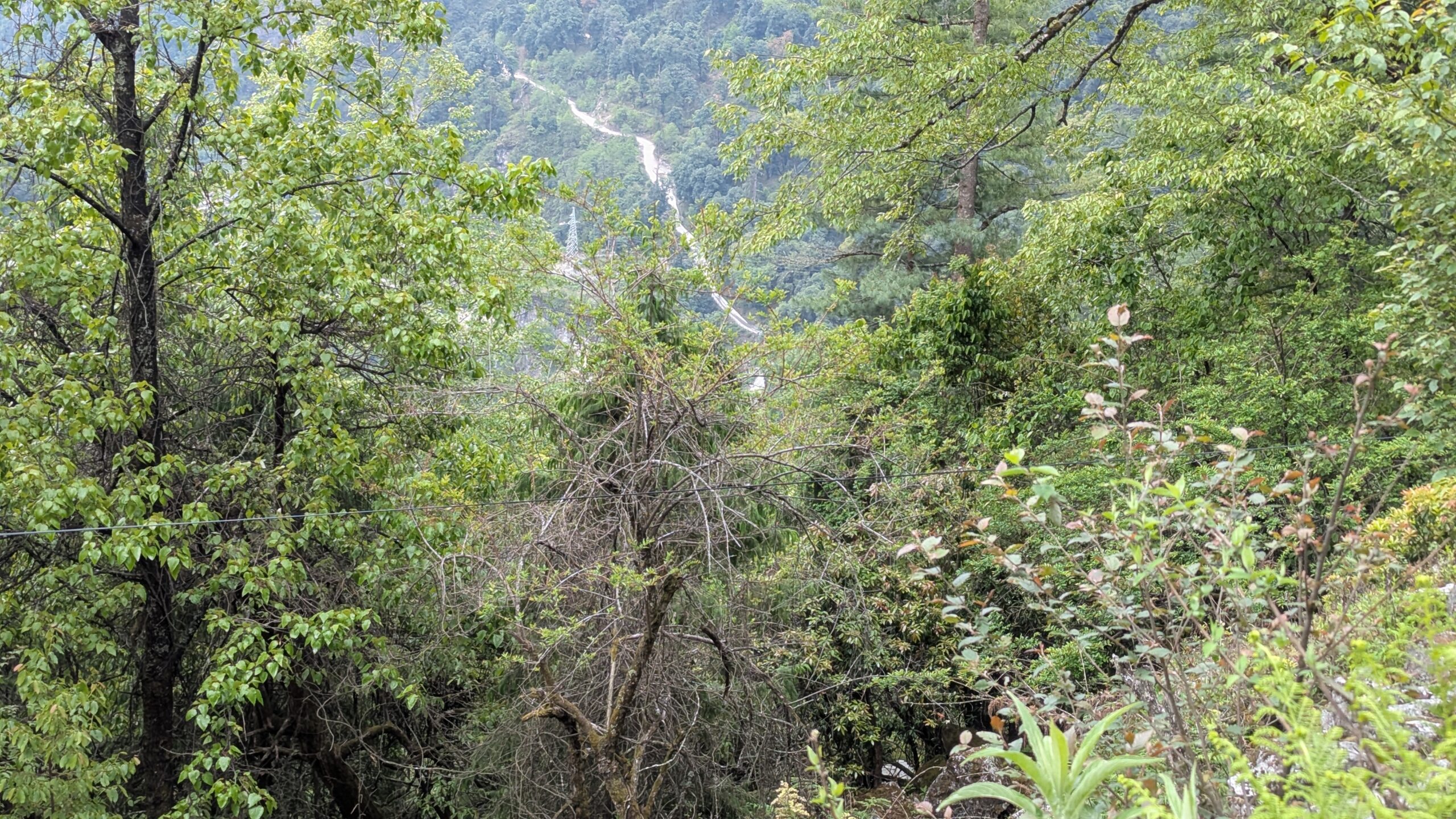
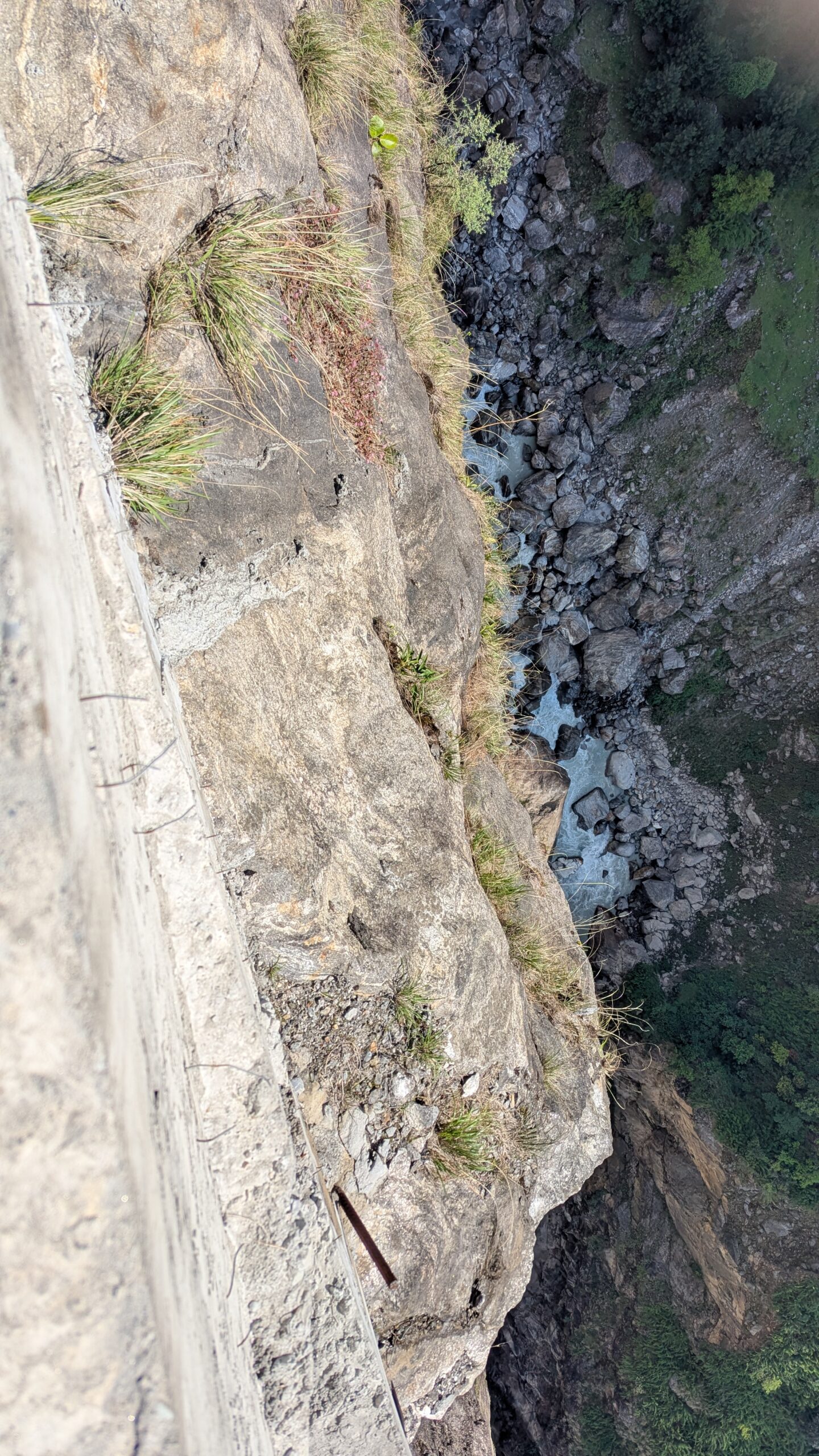
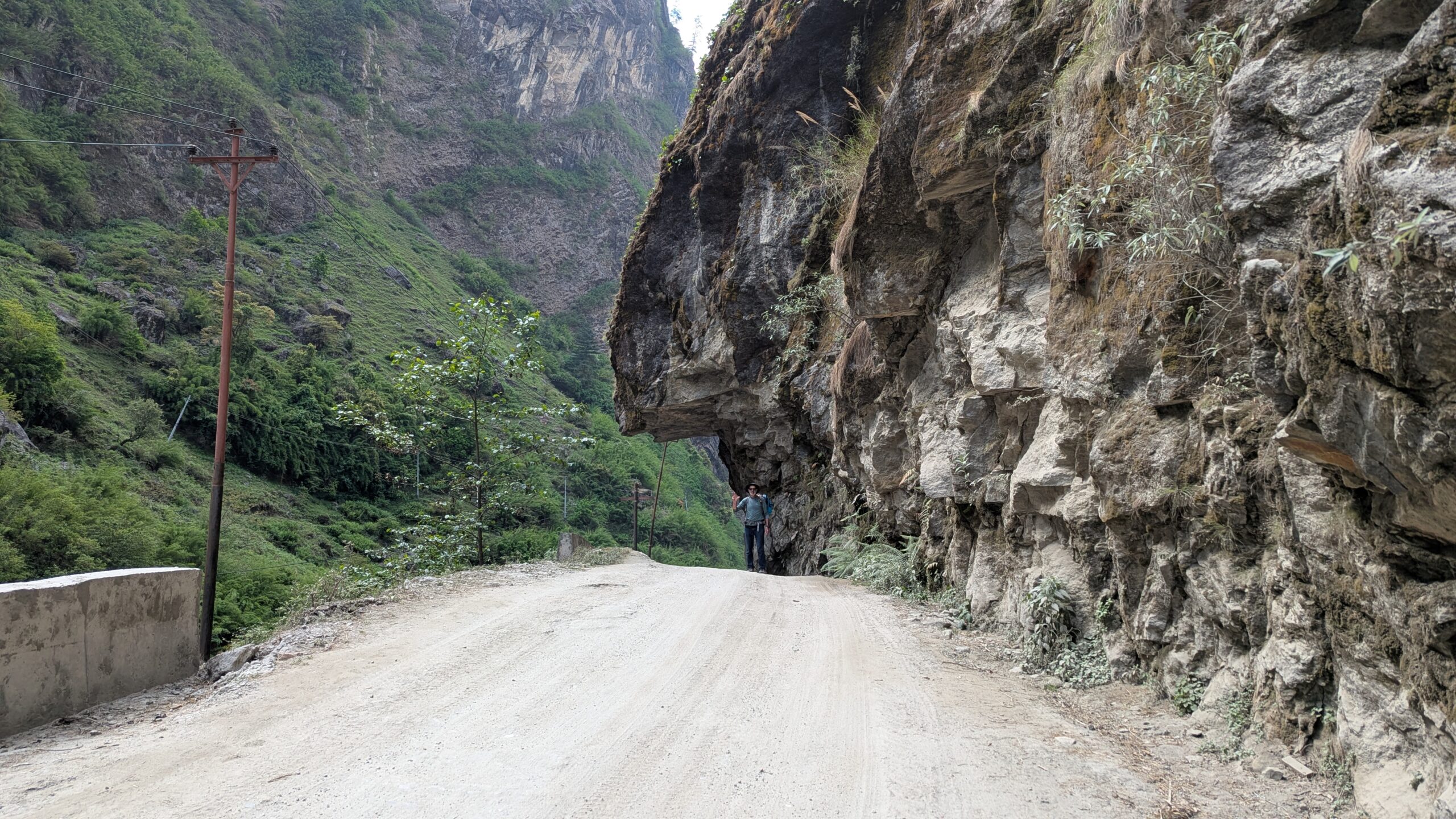
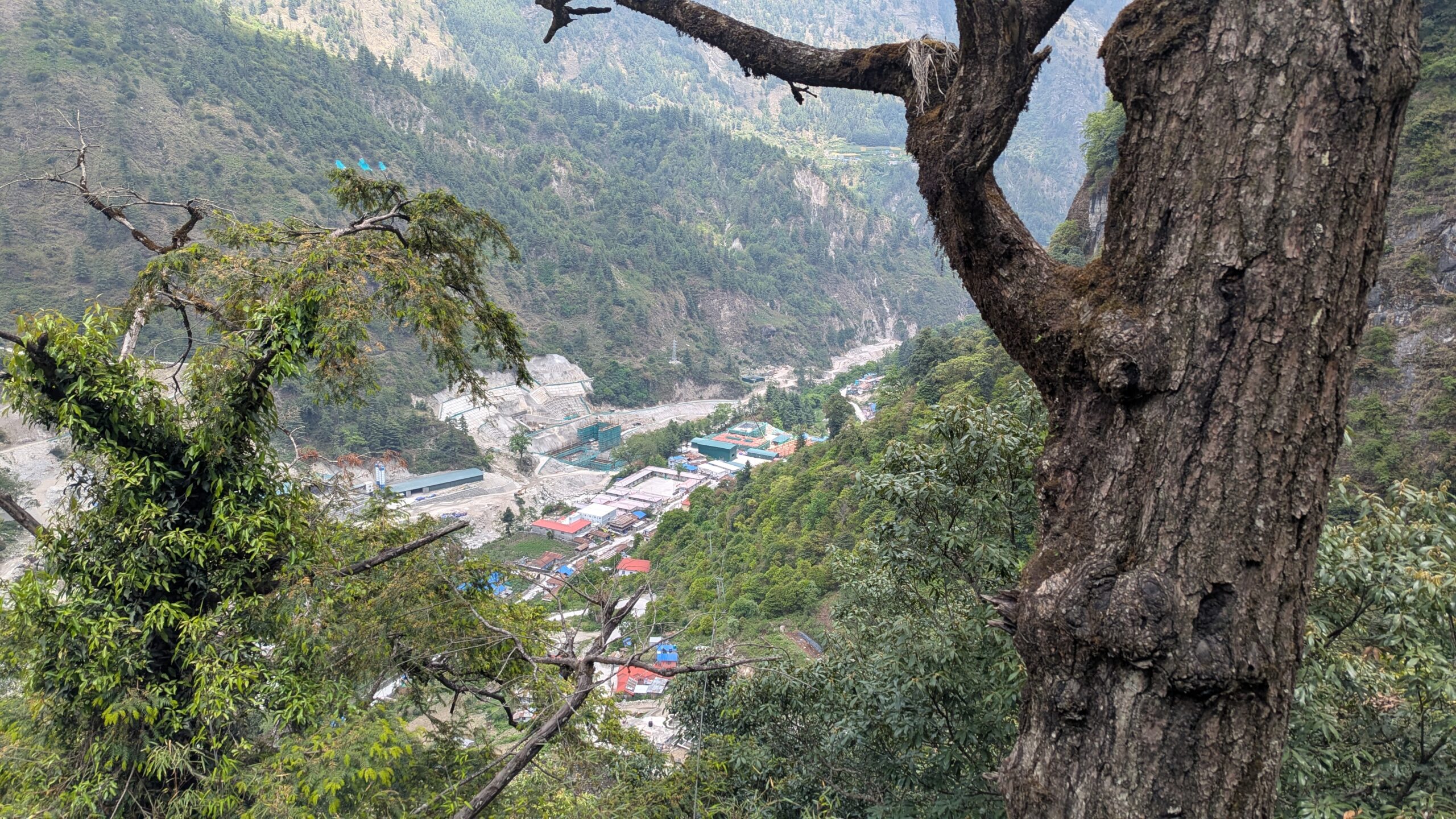
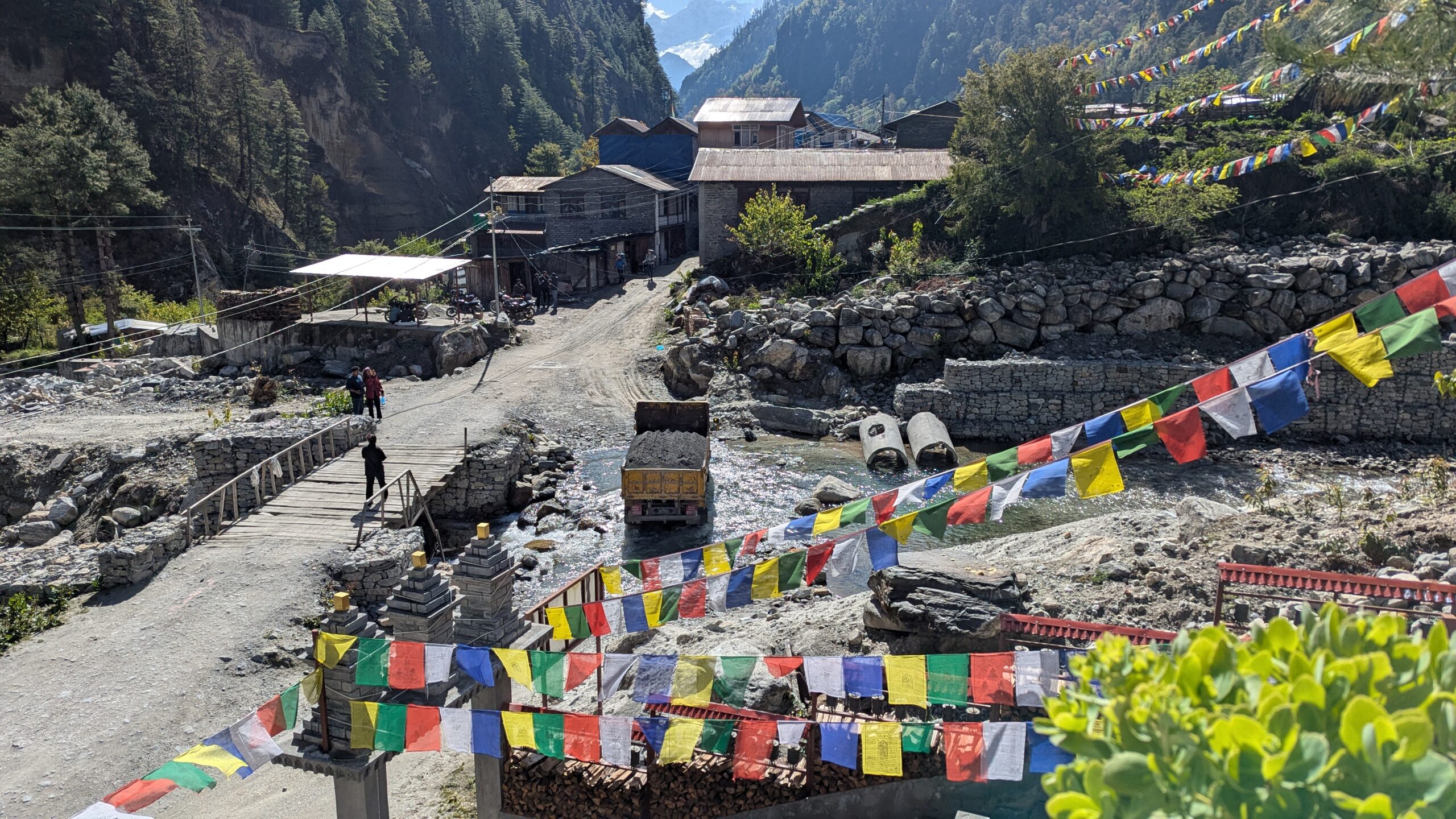
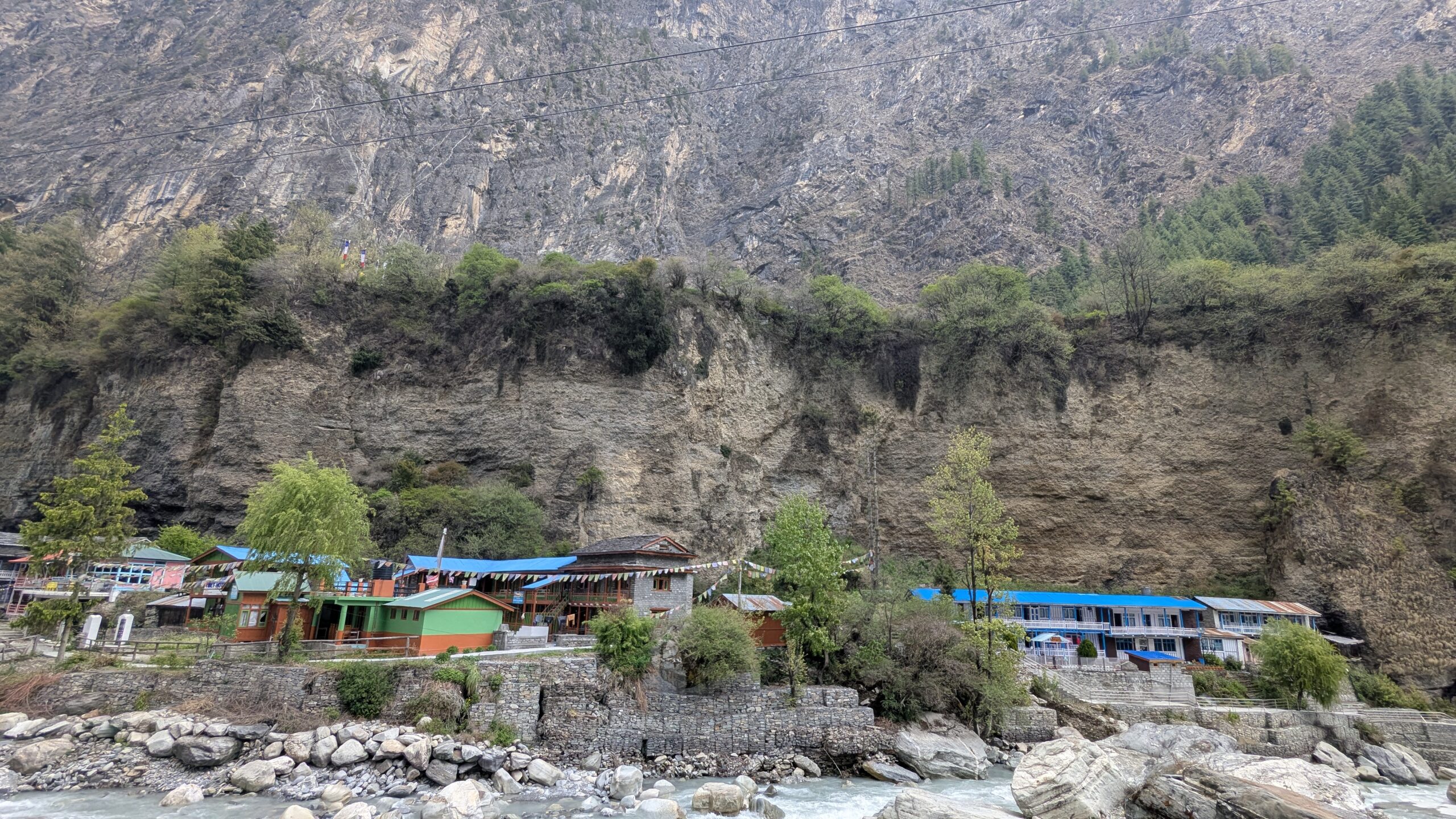
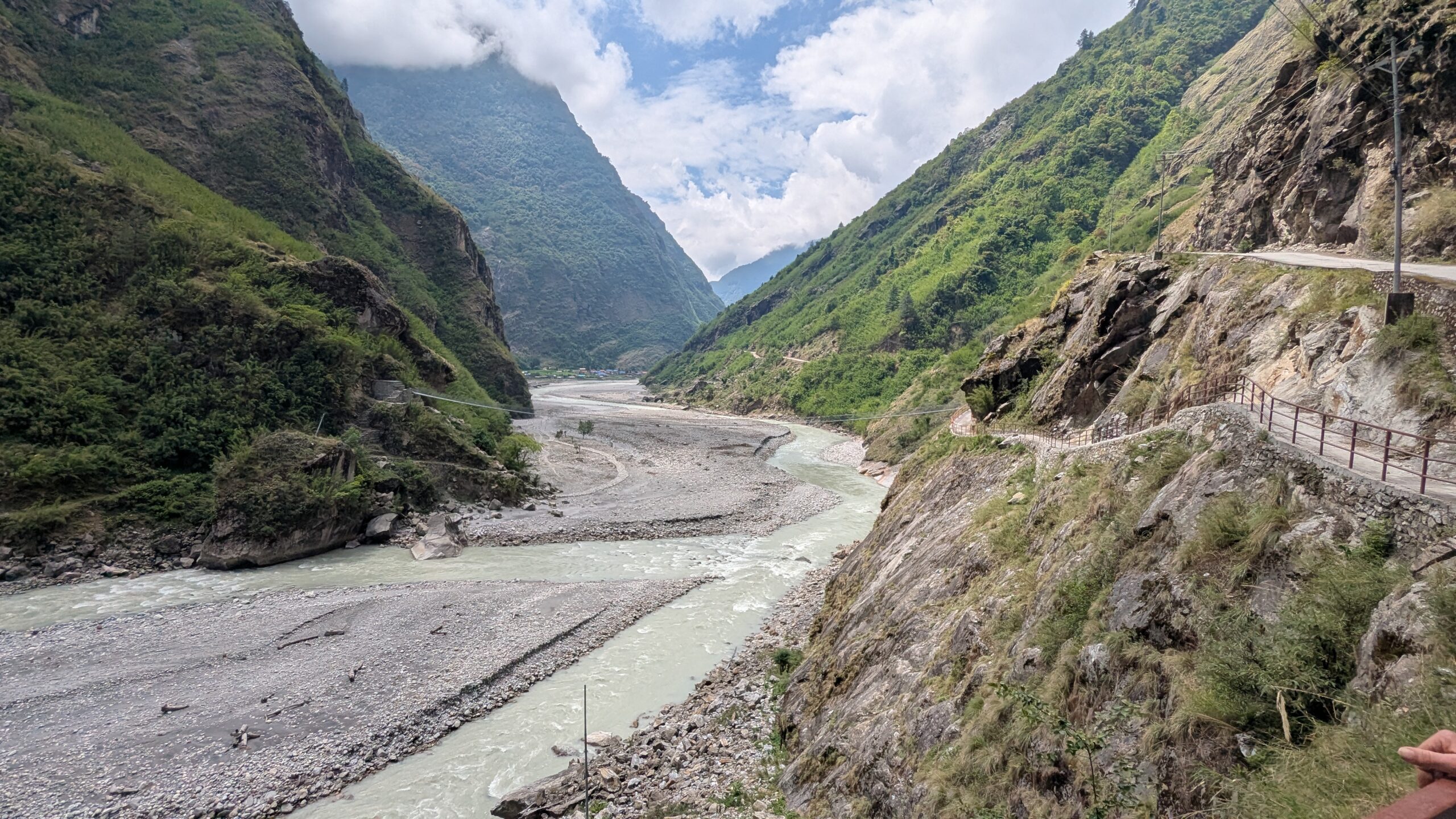
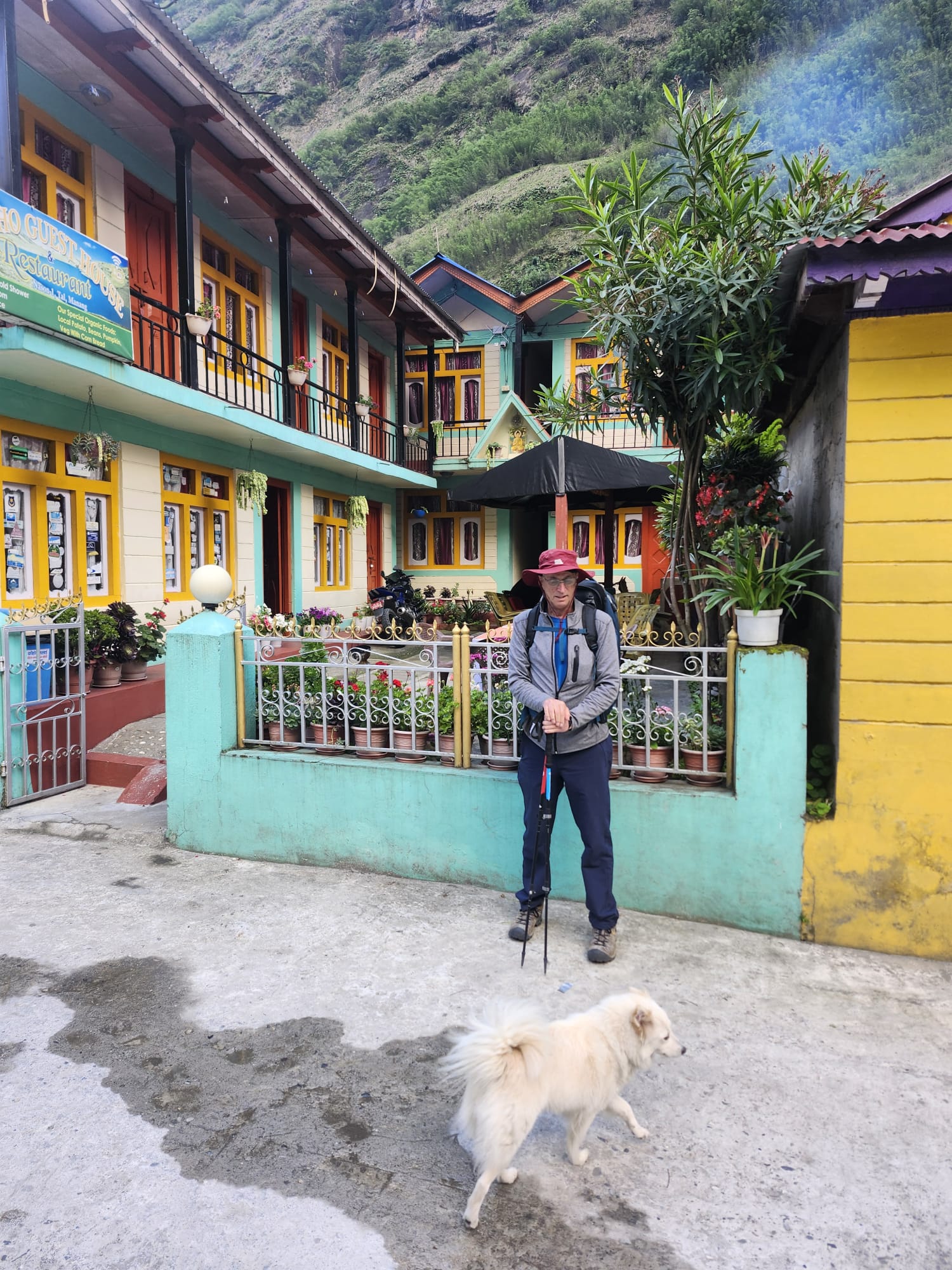
Howard with his pack on the start of the first day walking down. That day I sent my big pack (11kg) ahead by jeep. Where will it be, I asked? At the tourist checkpoint. No worries, it was there. The trees are slightly stunted but unlike in Canada where trees near the tree line are thin and tall, these trees are just small. They were bigger and bigger as we descended over the days.One of many waterfalls. only a few are big but many are very high. This one is about 100m high.Alan ‘drinking’ from a waterfall. It is not near, on the other side of the valley, across the river. We did fill water bottles from a waterfall, but unsure of what is above (sometimes there is a monastery or even a village) we added sterilizing tablets. That was my big 11kg pack, Howard graciously took my 3kg day pack on top of his – he is bigger, stronger, faster, younger.Yet another valley for the road to follow. The road, highway NH25, is on the left. This area of road was dirt, a single lane. In the rainy season, we were told that the river reaches the trees and the road can wash out.Oh look, a waterfall! …again. Getting used to seeing so many and so high, could be hundreds of metres.We struck gold! At the side of the road was a shoulder bag that obviously fell off of someone’s pack. No ID but better than that, a cube of hash like a big dice, a pre-rolled, a lighter and papers. We couldn’t leave it to go to waste. Howard got the innards, Tracy got the bag, it has a story behind it!At the Bob Marley hotel in Lower Pisang, she is the cement mixer. True to form, owner (we named him Foghorn Leghorn), wife Maya (Love in Nepalese) and trilingual 5-year old son, they had crops but also grew cannabis out back, 50kg last year. Junior speaks Nepalese, Hindi and English, Maya says he stopped talking Hindi but understands it. Kids can be kids. He was excited to show me all of the characters in his kids’ shows, every, single, one. He wanted ice cream because he saw it in a video: Maya said he finally had some in Kathmandu and complained that it was cold. He failed to make the connection between ice and cold.Cutting lumber for posts on a homemade table saw. Building two new luxury rooms (because they have own toilets, no heat) in the Bob Marley hotel. Foghorn Leghorn paid the workers CDN$25 a day, total. The saw was very underpowered, took several minutes for one cut. It has the ubiquitous “Nepalese plug”, wires shoved into the outlet and everyone walks on the wires. What could possibly go wrong?More of the road, officially highway NH25. Parts of this fancy section had a concrete barrier. Yes, we did throw rocks into the river, of course.Trucks on the road, slowly moving along. Hope nothing comes the other way. We are on the same road and will be there soon. This had a rare retaining wall, below the red truck. There is a swing bridge (foreground) for trekkers and locals to cross the river. The swing bridges can be long, maybe 200m, very well made with 6 or 8 cables, all metal. Yes, we did throw rocks into the river, of course.Like a thousand years ago, a man leads a goat while wife carries a basket. He has a leafy branch behind to keep the goat following. However, the anachronism is that she was talking nonstop on her mobile. Old meets new.We are heading to that road below, on the way down. A hydro tower is visible just left of centre, for the new hydro dams being built by China.In many places the side of the road drops off almost vertically to the river far below. Of course we threw rocks down.Boys will be boys. The road drops off into the river, not the steepest or highest or scariest but good enough. Howard threw a good rock down, it bounced and smashed but reached the river. It was fun.Howard on the road blasted into the rock wall, drops off to the left way down into the river. One crane truck was stopped in a tiny space at another such place, too big to go though, too big to back up, choices are to abandon it or start blasting the wall until it fits. Someone measured wrong!Chamé far below, will take a while to walk there. Nepalese script has an almost continuous line on top joining the letters. “Chame” is a transliteration. Although it is not written with the accent ague, I did because all words ending with “e” have an “eh” ending. Nepal uses Hindu-Arabic numbers like us and use English pronunciation, which makes listening to Nepalese fun. Most places around the world now now use Hindu-Arabic numbers, even the Romans.In Chamé, the well known Indian eating place (restaurant would be a stretch). Owner mixes and cooks whatever goes into the hot oil (of unknown vintage). He speaks English. A jeep delivered my 11kg bag there for C$4.50. We stayed across the road for two nights, lovely people both here and the hotel and around town.Chamé, the truck is too heavy for the bridge so it fords the river, a tributary of the large river dividing the village. In the rainy season, the truck might wait a few days for the water to go down, spends their time in the Indian place drinking chai, eating fried bread with fried sweets.Part of Chamé on the other side of the river, a small farmed plateau then a vertical wall.Our first view of Tal (at last turn of the river), a dying village because the highway (upper right) bypassed it. We took the trail (lower right), crossed the pedestrian suspension bridge (look carefully just below the centre of the pic) to get to Tal. Of course we threw rocks into the river from the bridge. We are told that in the rainy season, the river floods onto the flood plain, hence the name. A modern concrete wall barely helps protect the village.That’s me talking to a dog, it didn’t reply. The village of Tal had about a dozen hotels, some abandoned and falling down, those still open are desperate for trekkers. We were the only ones at this hotel. Sad. The government had the dog neutered in an attempt to the reduce number of stray dogs. The dogs are all friendly and usually silent. A few times a dog would hook up with us and hung around for hours as we walked. One particularly calm and friendly dog we named Shanti, means peace in Nepalese and Hindi. Howard’s favourite was Blackie, until one time it growled at him and became an ex-friend.
* The last afternoon walking we hitchhiked
After several days walking, we had too far to go with not enough time to reach next town so we hitchhiked and got a ride in a truck.
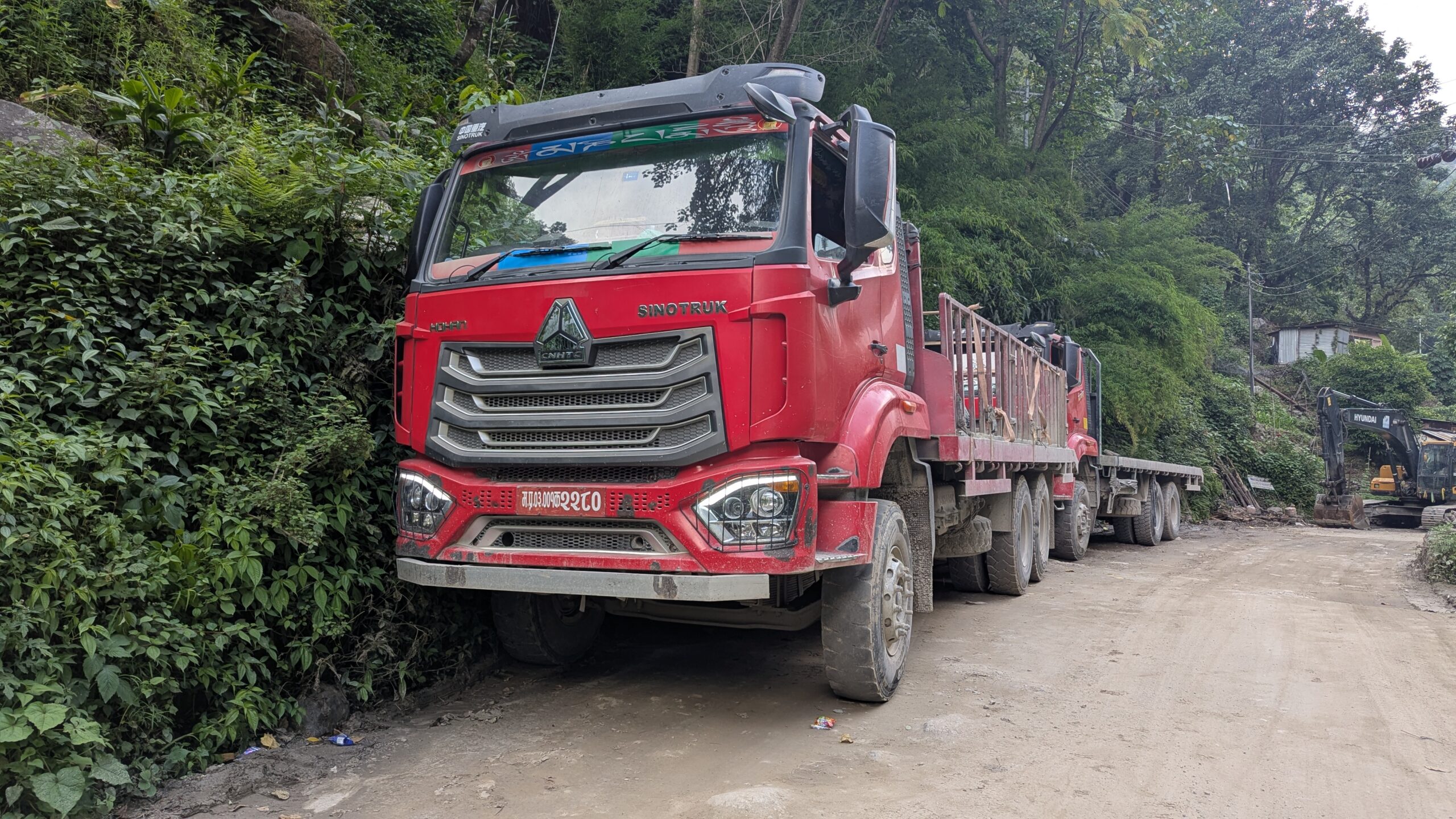
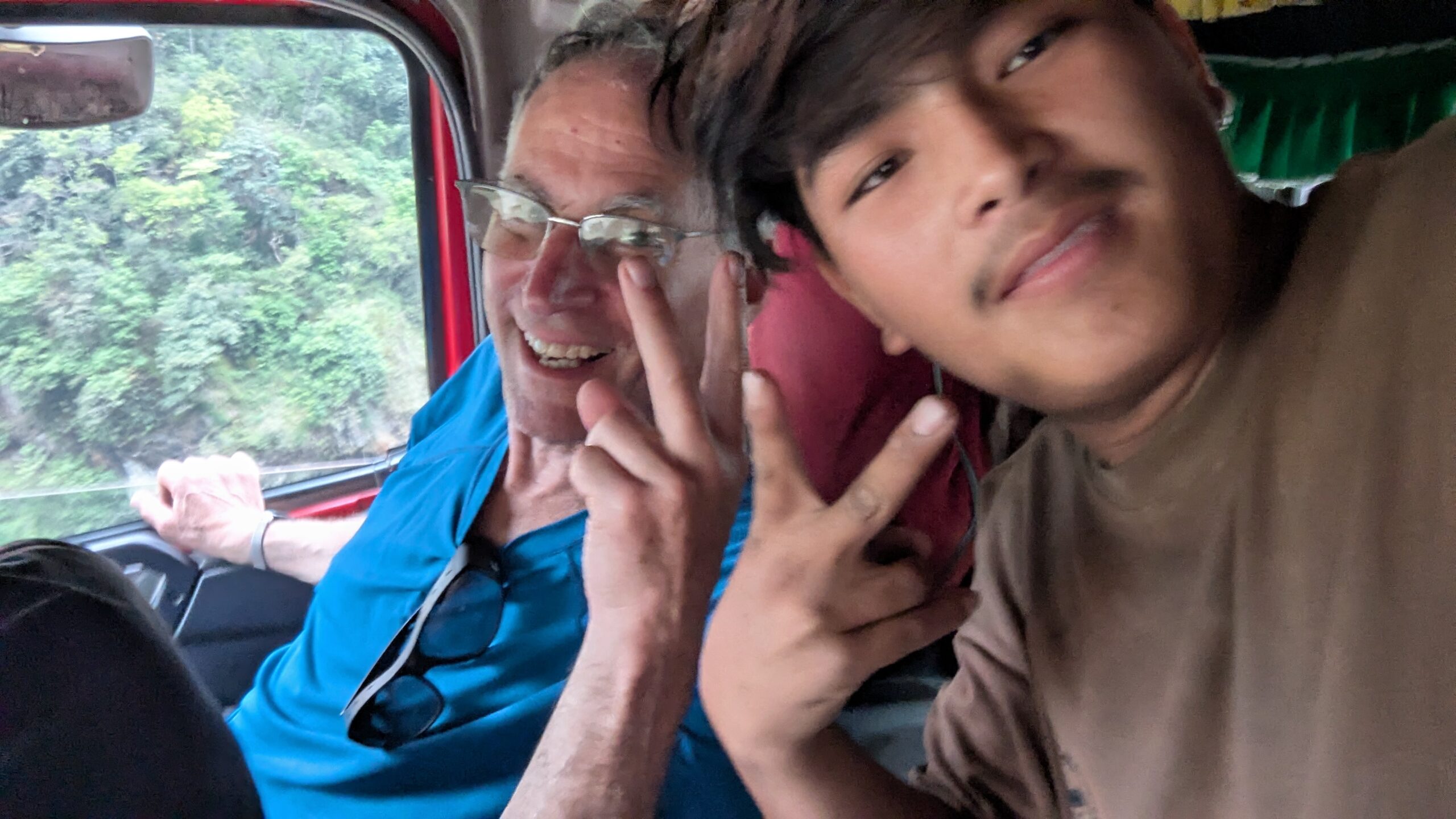
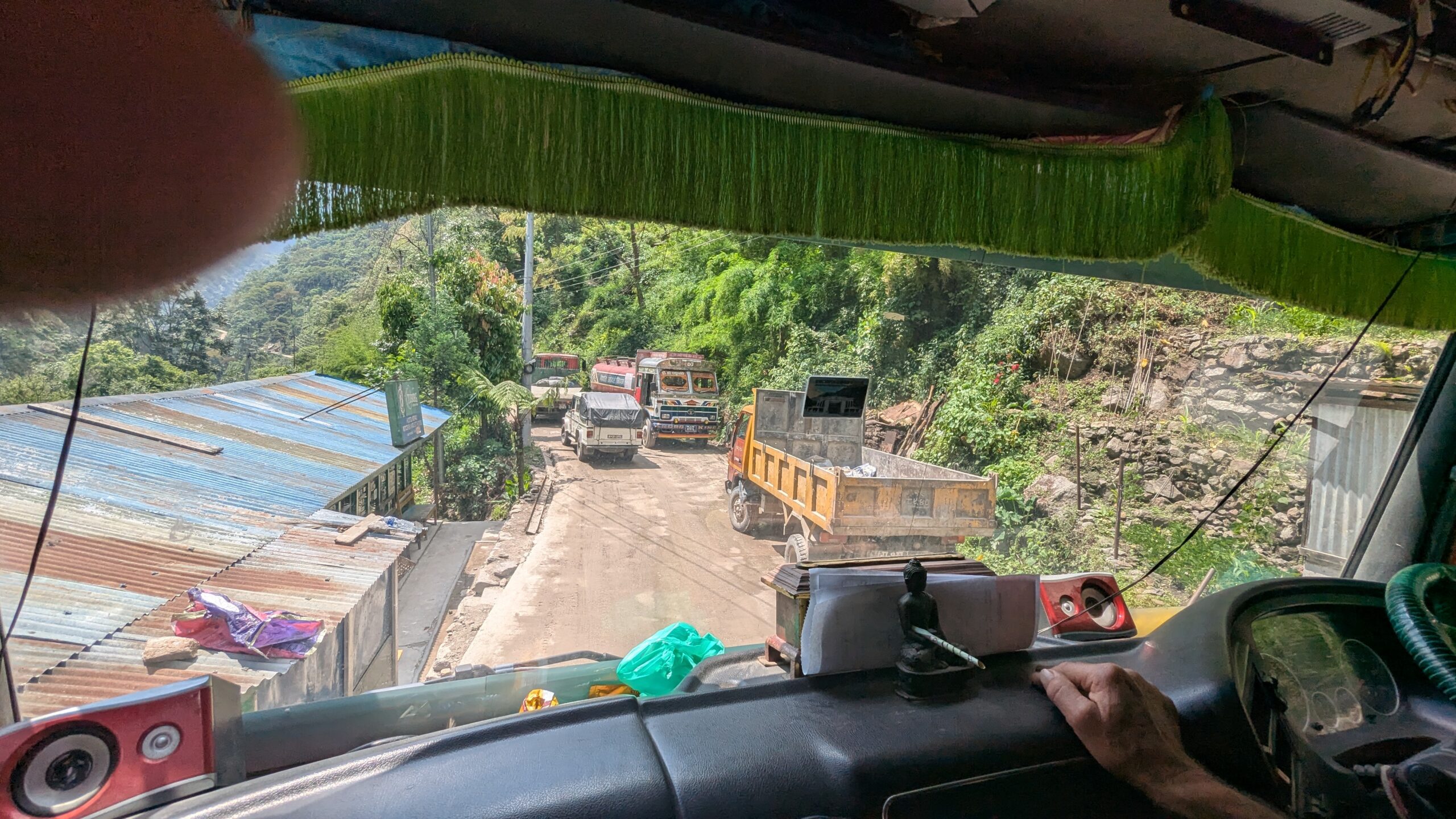
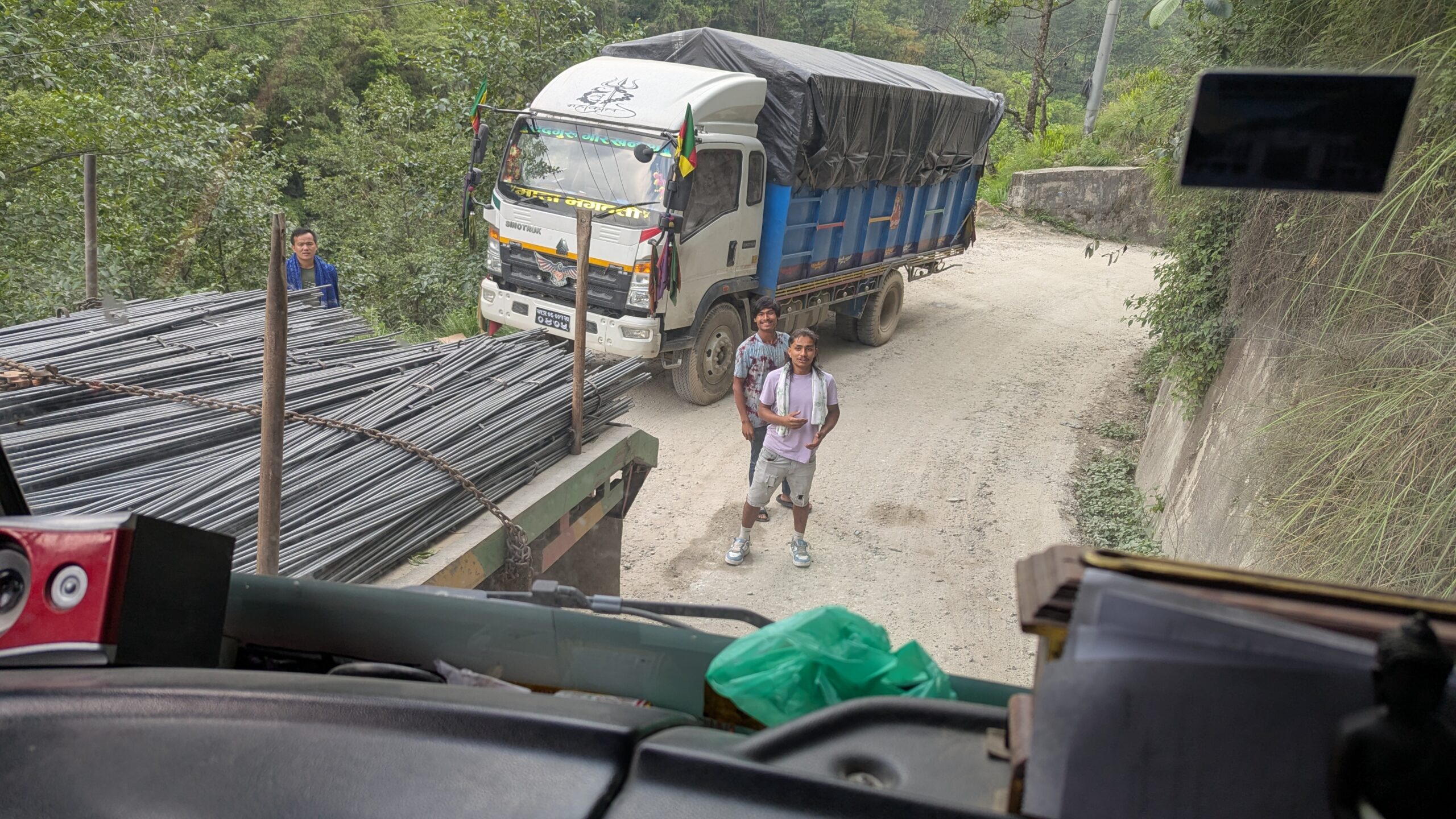
Our truck waiting for the road ahead to be cleared. Note bald front tires. It is 8-speed (got into 4th one time) with option for all 10 wheels drive. Bounciest, roughest ride possible. Driver spoke no English, his young assistant managed a few words but was curious and friendly. Took 3 hours of driving to cover 30km. They would not accept any payment, after we regretted not asking them to give it our cash (equivalent to C$18) to someone who needs it. They would definitely have done so, to keep it would be wrong.Alan with the young assistant, he wanted the selfie. For some reason he never learned English, the ride was far too bumpy to type so could not use the translate app, unsure if he was literate although all children go to school.The road was cleared (rock fall? construction?) after a few hours, all these trucks started moving again. That is the truck stop on the left. Howard said not to eat anything there unless it came in a sealed bag, of which there were none.We had to pass this truck, just enough room. They are stopped right at the edge, probably with one or two tires in the air. Those other driver and assistant guided us through. We could and did reach out to touch their truck on one side and the rock wall on the other. Actually, when maneuvering we did get jammed against the rock wall, no damage just scrapes. No idea why the mirrors don’t fold in to give more space.In the truck, bouncing along. This was a great stretch, could drive fast. The road drops off on the left into the river far below. Don’t think about it, look ahead.
* Besisahar to Kathmanu
We took a bus from the town Besisahar in the foothills into Pokhara, Nepal’s second biggest city, than back to Kathmandu from where we flew back home via Delhi in India (was 44° there!).
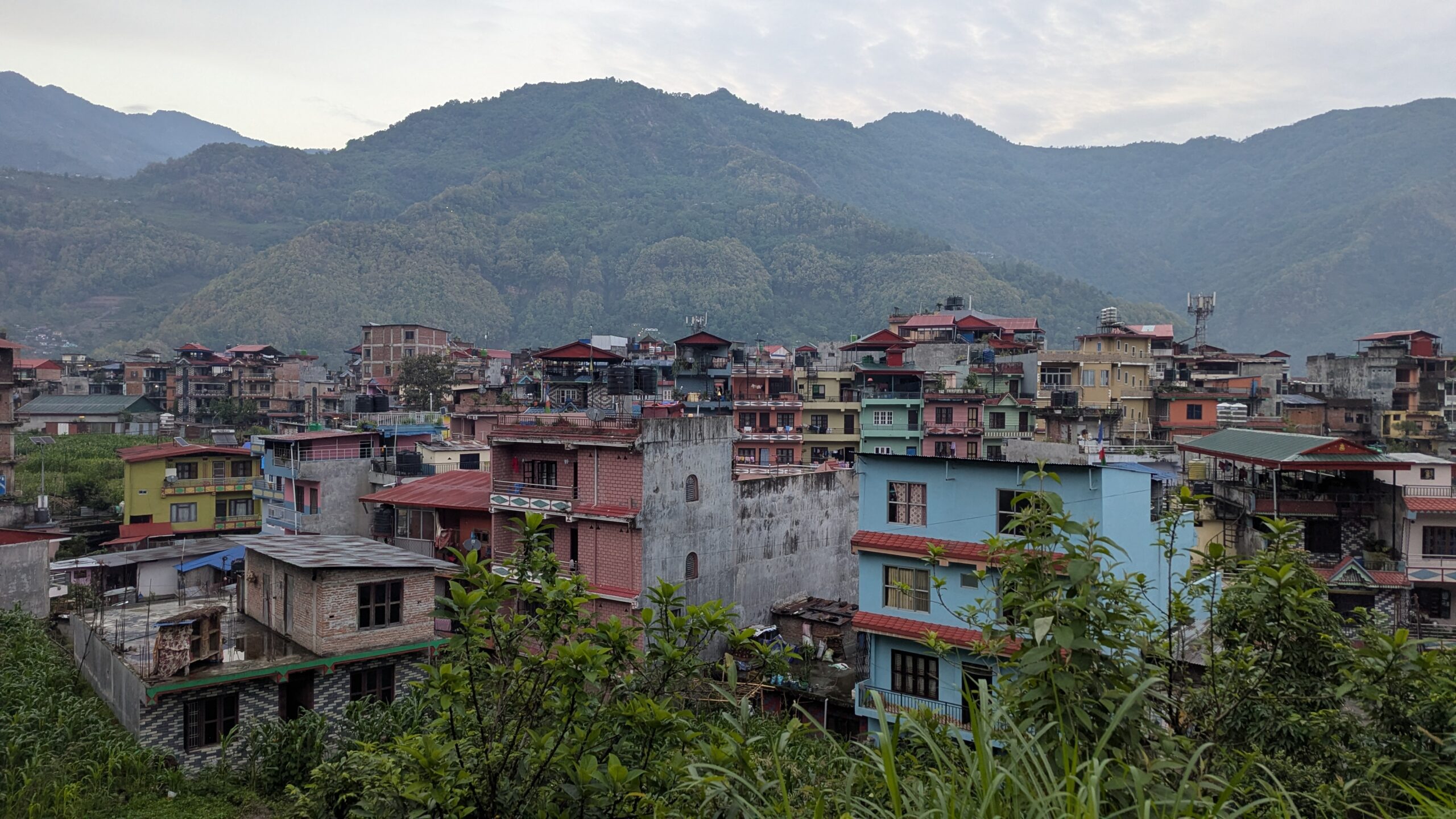
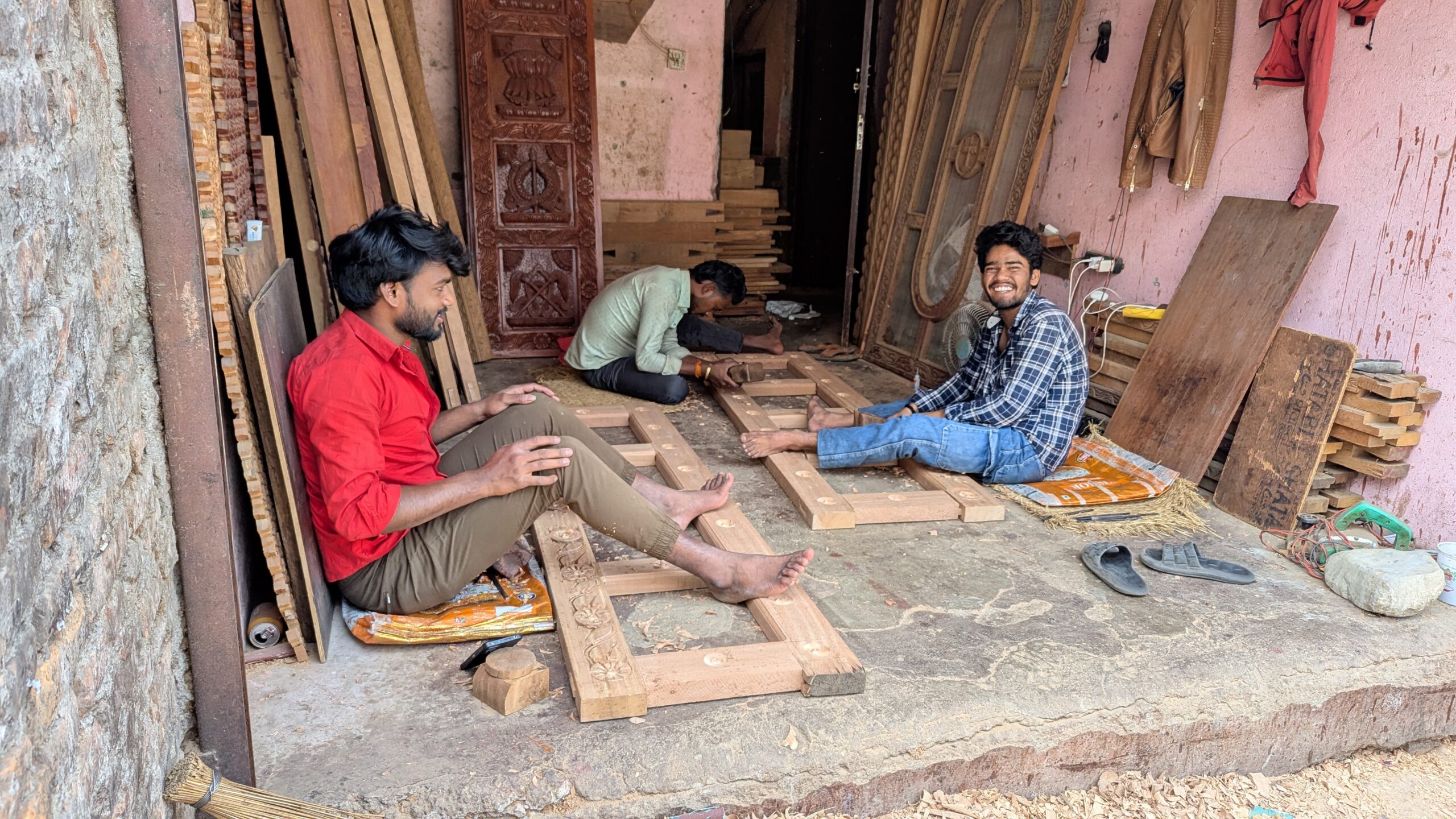
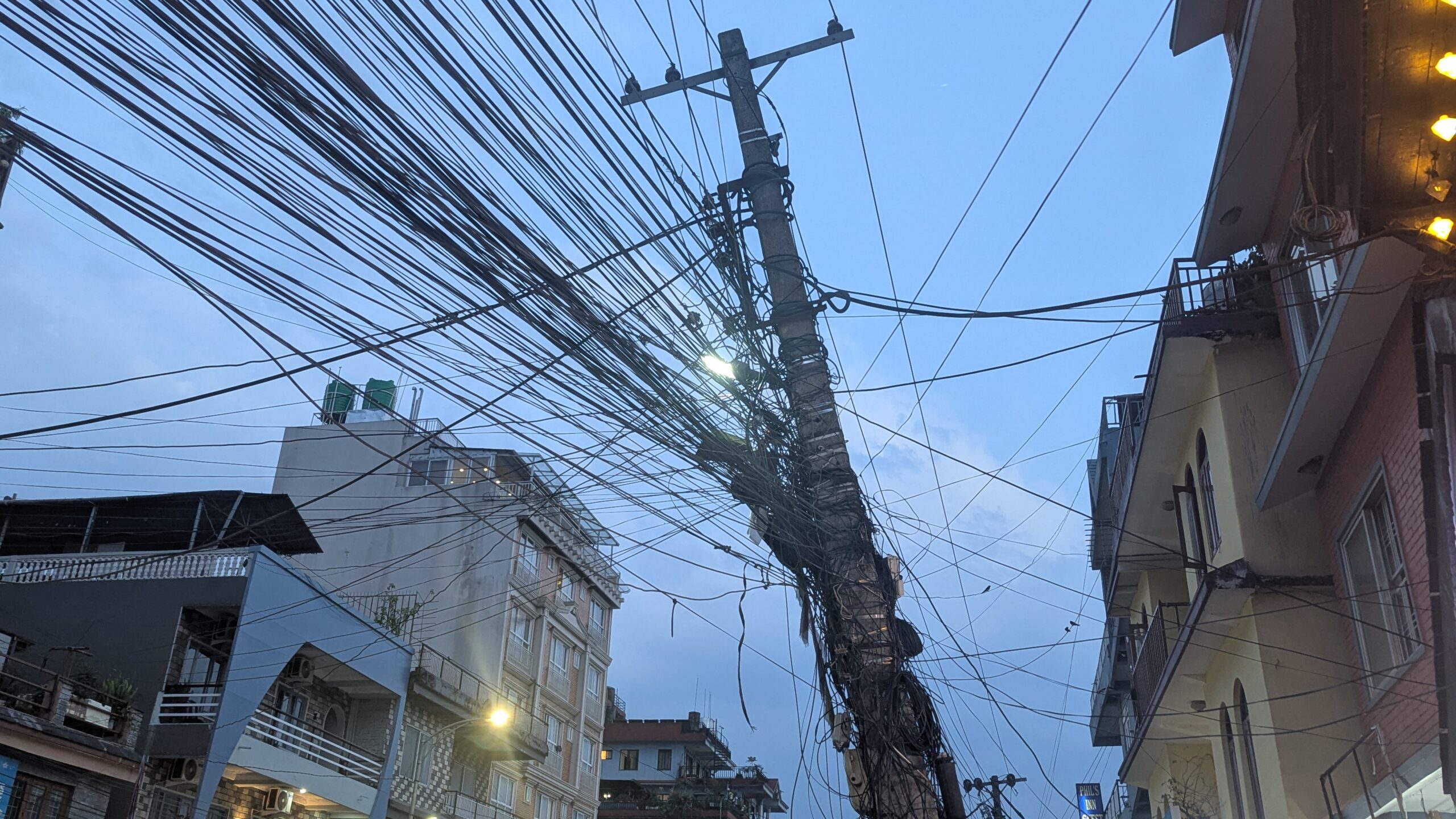
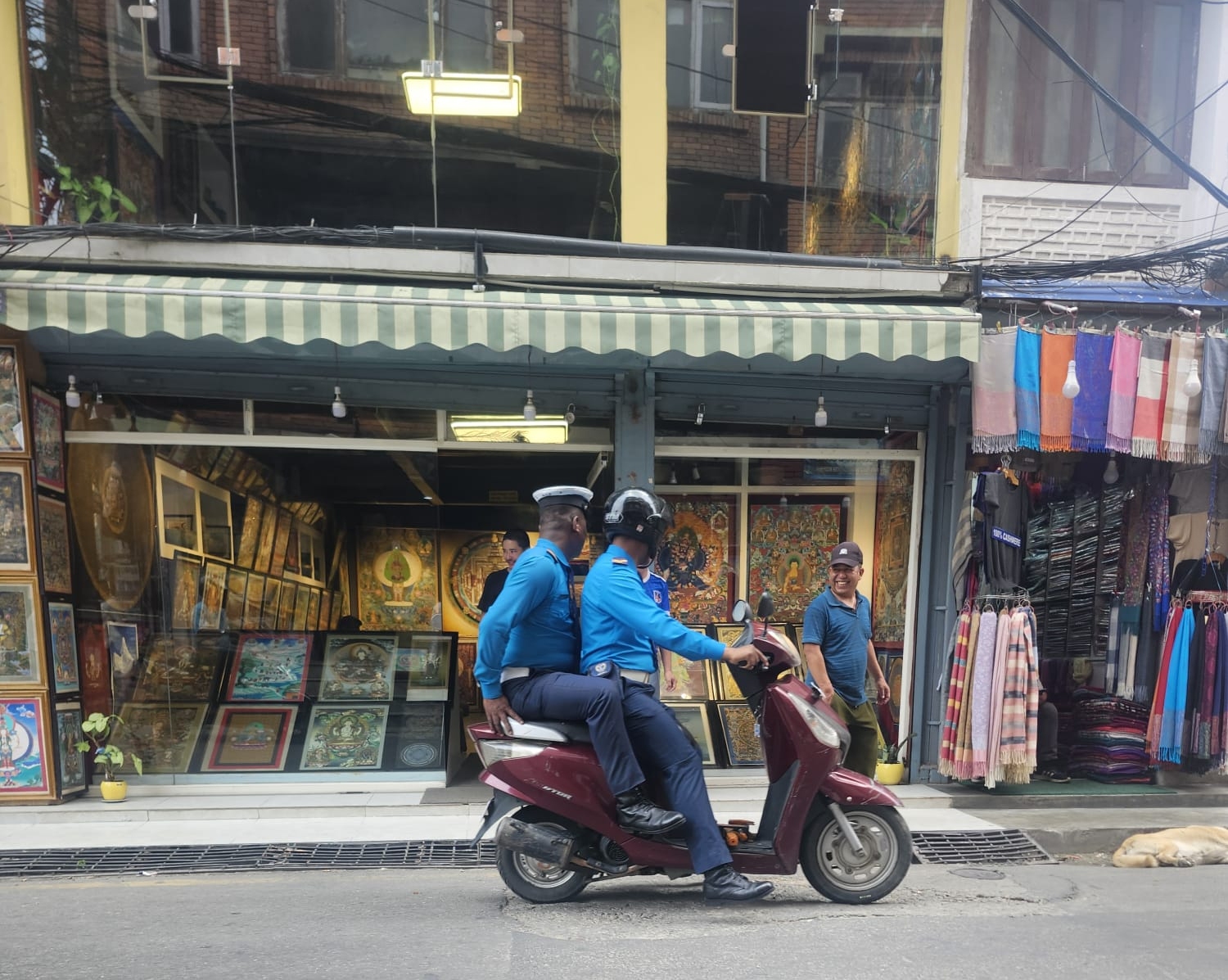
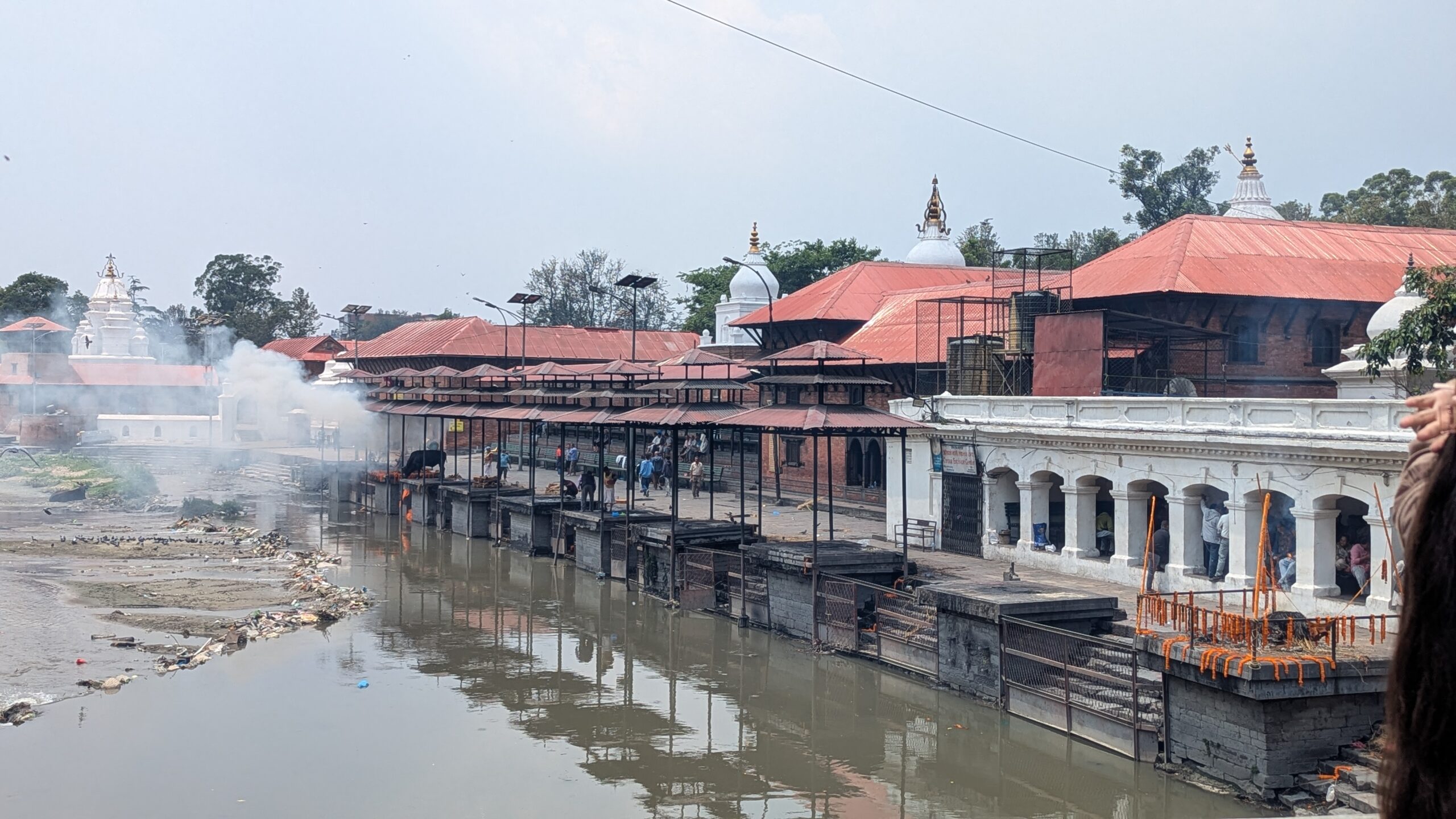
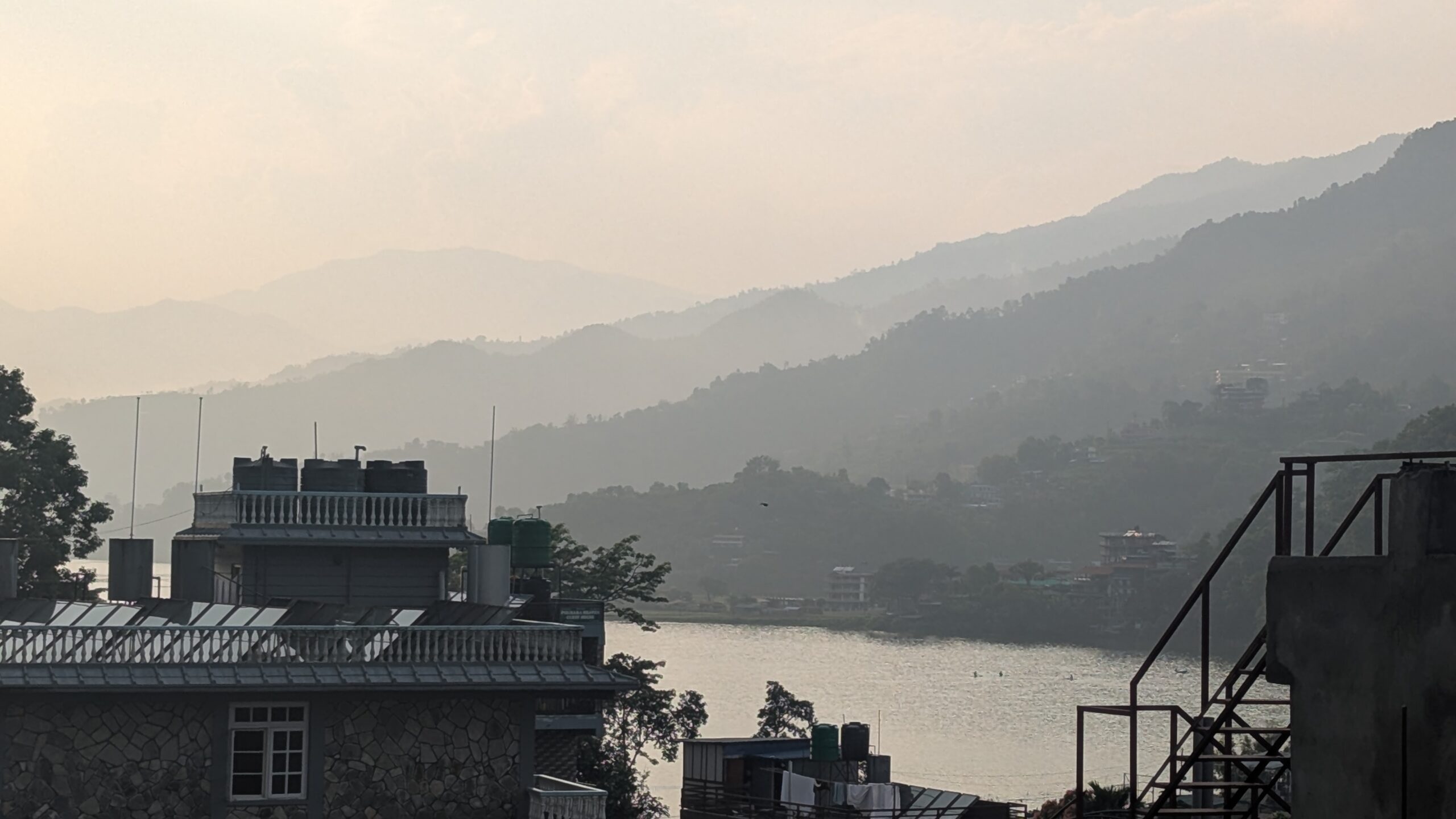
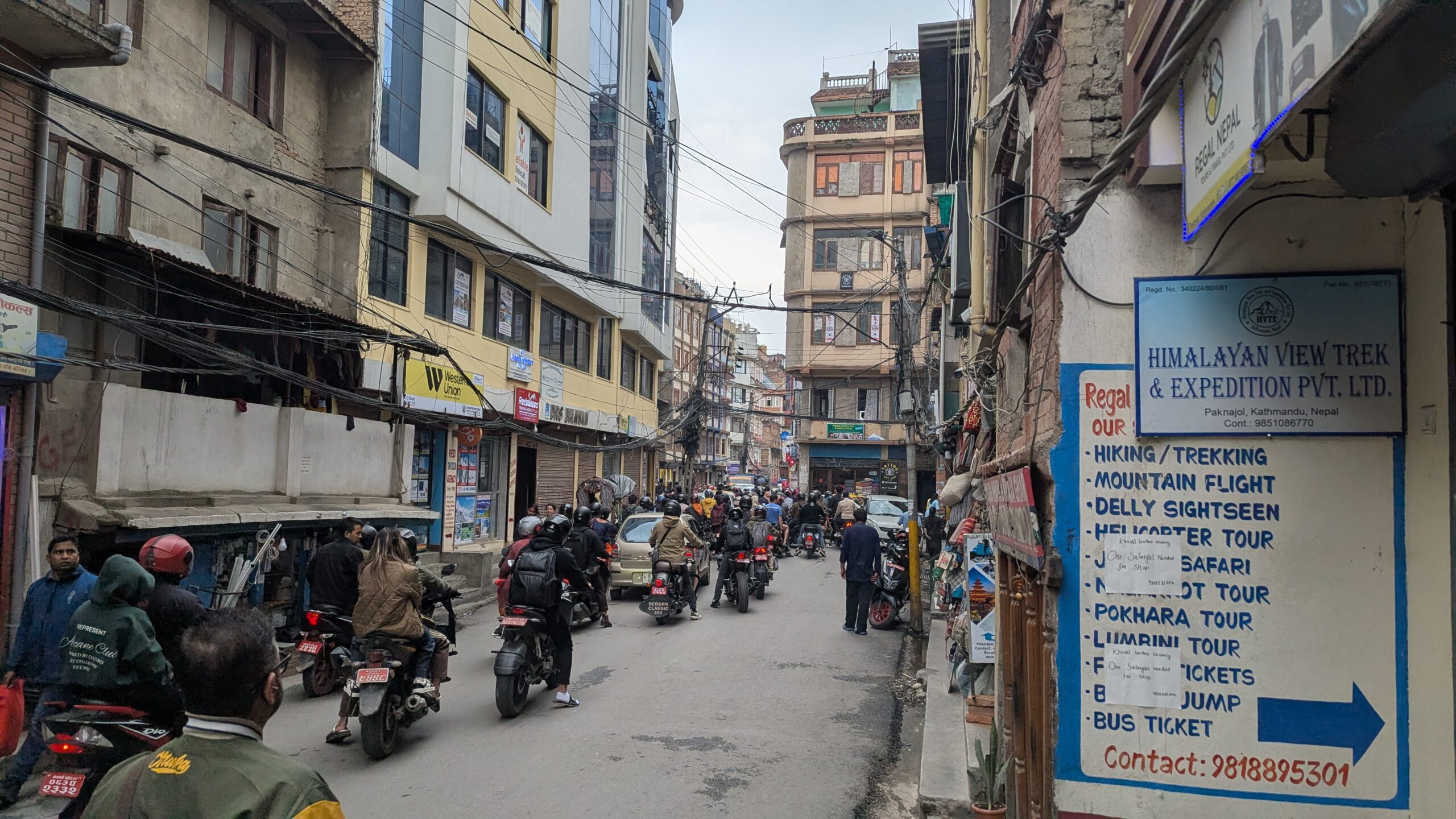
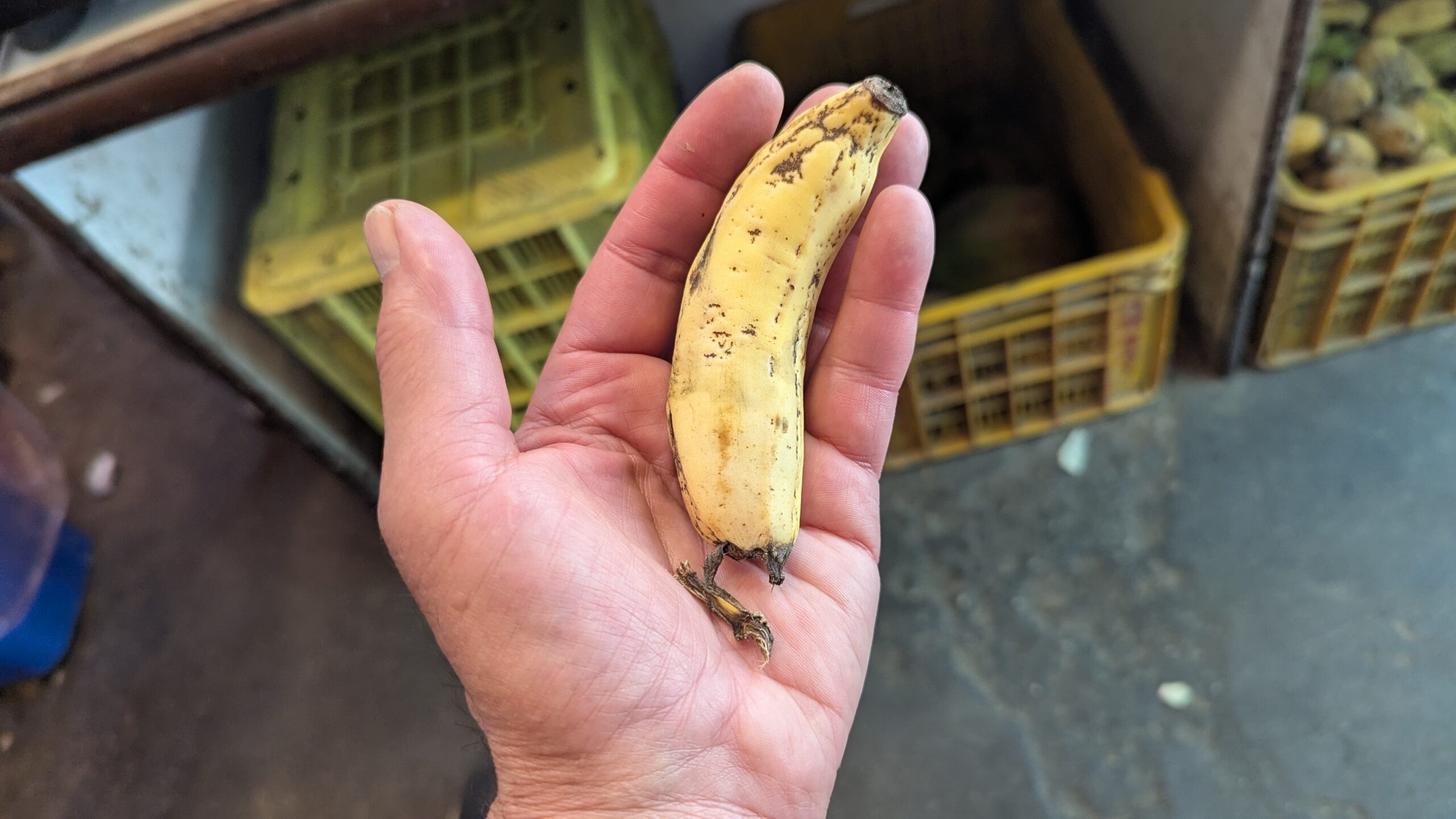
Near the edge of Kathmandu. The real downtown does not have any greenery.One of many places that hard carve wood panels for temples and houses. As always, friendly, happy to be photographed, although everyone has mobiles. I did not see any door to the shop nor any way to close it off at night. The artistry is very impressive.Typical telephone pole, masses of power and old telephone(?) wires. These are monkey highways. The hydro company charges the city for power and it is up to the city to collect from each house and business. Especially in the mountains, cooking is by propane, never electric, although in the mountains wood burning is very common. Mobiles are everywhere so most of those small wires are obsolete now.Cops on their 150cc(?) scooter doing parking control. They had two wheel boots at their feet then when we saw them later they had only one. We laughed with them about someone having to pay a fine for really, really bad parking of a car or motorcycle. Cops are very friendly, no guns but sticks, sometimes. These two are laughing with someone they probably know. Once while waiting we spent almost an hour talking (via translate app) to a few cops. They were as curious about us and policing in Canada as we were about them. Amateur cops, don’t even know that they are supposed to be aloof and arrogant like most police around the world, unlike how ours used to be. Did I just complain?In the small Hindu district, a row of cremation huts. Only one person cried, others were blasé. After the fire is out, the workers pan for melted gold and silver. Cows wander around, tourists gawking. No one seemed to mind the watchers. How would we feel if a tour guide was yapping away to a slew of tourists while our mom was being buried? Different place, different attitude.In the tourist district, the lake with rental paddle boards, mountains in the mist. Kathmandu is 1,700m up so cooler and more mountains that lower down.Typical street in Kathmandu, full of small motorcycles and scooters, some cars, people walking among them, no sidewalks. There are a few electric cars and scooters, in a few years there may be a lot more. Gas costs about the same as in Canada, electricity is cheap. No sidewalks, you walk on the road, Howard’s arm was hit by mirrors a couple of times. There were many subtle and not so subtle sings of injuries, including one man with only one partial leg who got around these streets on his knuckles, I gave him some money (equivalent to C$9) for which we exchanged namasté. Motorcycle and scooter drivers require helmets, passengers do not, some women ride sidesaddle. The police in one place were doing breathalyser tests: holds it just clear of the driver’s mouth, they blow and are waved on, fast and efficient.This is the standard banana size, hand for scale. Would be nice to have that size here.